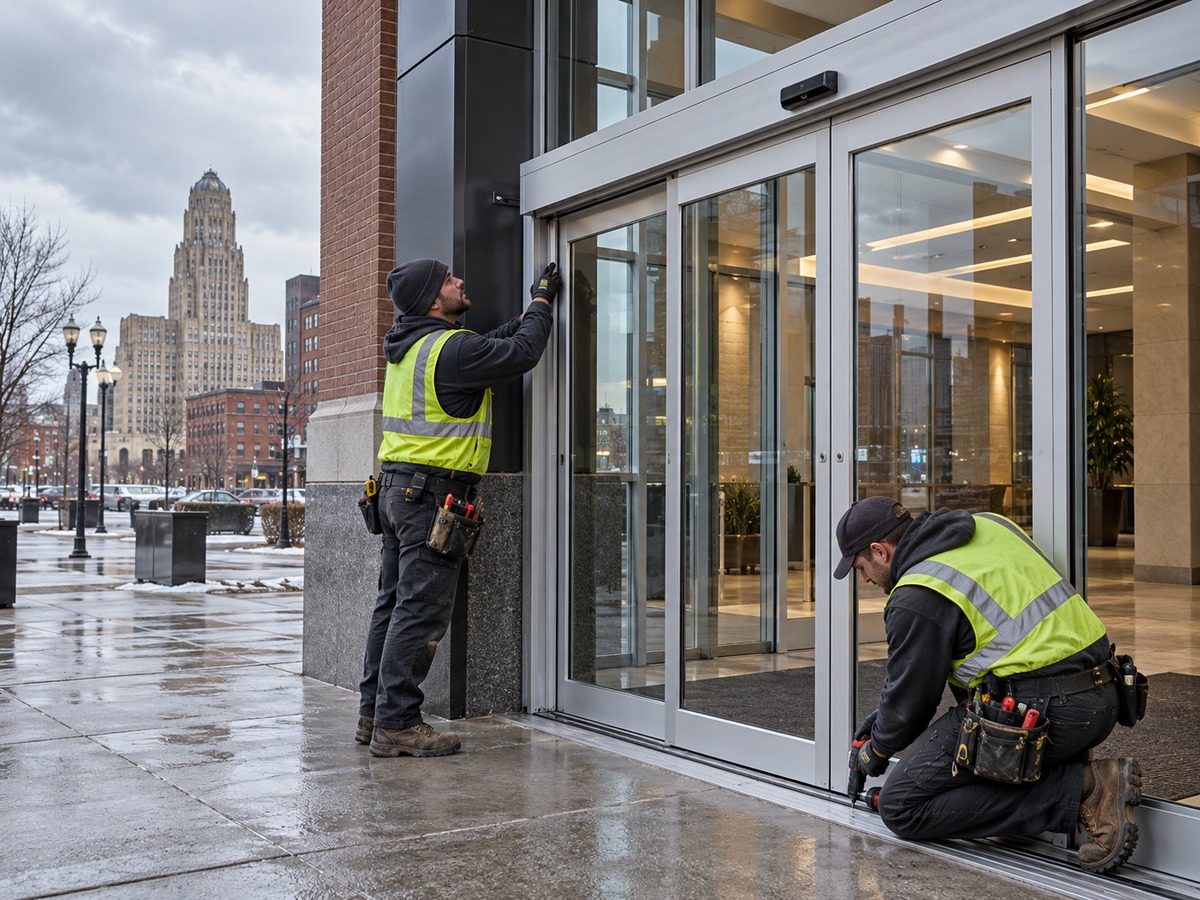
Across Buffalo, more commercial automatic sliding doors are being replaced rather than patched, and the reason is practical. Many of the automatic entrances on storefronts, clinics, grocery stores, and office lobbies in the region were installed years ago, and they are now reaching the point where the operator parts are hard to source, the header is worn, and the door needs service often enough to interrupt business. A-24 Hour Door National works with building owners and facility managers across Buffalo and Western New York on exactly this decision, and the pattern is clear: once an automatic sliding door starts failing regularly in winter, replacement usually makes more sense than another round of repairs.
Several forces are pushing Buffalo businesses to replace their automatic sliding doors at once. The first is age. An automatic entrance is a machine, and the operator, drive belt, carriers, and sensors all wear with use. A high-traffic door runs thousands of cycles a week, and after years of that duty the components reach the end of their service life together. When the manufacturer has moved on to newer operators, the old control board or gearmotor can become difficult to source, and a repair that once took hours now waits on a part that is no longer stocked. At that stage, replacement with a current system is the move that actually restores reliability.
The second force is winter. Buffalo sees heavy lake-effect snow, freeze-thaw cycles, and cold that tests every entrance in the building. A slider that opens slowly, fails to seal, or sticks in the cold lets conditioned air escape with every opening, and over a long heating season that loss adds up on the energy bill. Owners are looking at their aging entrances and recognizing that a faster, properly sealed automatic door limits that infiltration while keeping the lobby comfortable. The third force is accessibility. As entrances are upgraded, the new low-energy operators and sensors bring the door in line with the 2010 ADA Standards and ANSI A156.10, which matters for the medical offices, retail, and public buildings that make up much of Buffalo's commercial base.
A failing automatic entrance usually gives warning before it stops entirely. The door may open or close slowly, hesitate, or reverse without a clear reason, which often points to a worn belt, a tired gearmotor, or a sensor losing its pattern. It may grind or bind in the track, a sign that the carriers or rollers are worn or that salt and grit have worked into the header. The door may fail to seal at the meeting stile or the threshold, letting a visible draft through on a cold day. Sensors may misfire, holding the door open or failing to detect someone in the path, which is both an energy problem and a safety concern on a power-operated pedestrian door.
When these symptoms arrive together, or when the repairs needed to address them depend on parts the manufacturer no longer makes, the door is telling the owner it has reached the end of its useful life. A-24 Hour Door National reads these signs during a free assessment and gives a direct recommendation rather than selling a replacement by default. Where a targeted repair will restore the entrance, that is the honest answer, and the company's sliding-door repair work covers it. Where the operator is obsolete and the failures are recurring, replacement is the path that stops the cycle of service calls, and the two options are laid out side by side so the owner decides with the full picture.
The concern owners raise first is disruption, and it is a fair one. A retail entrance or a clinic lobby cannot simply shut for days. Commercial automatic sliding door replacement is built around that reality. The new operator, header, panels, and sensors are matched to the existing rough opening so the storefront and glass line stay intact, which avoids the larger construction a full opening change would require. The work is often phased or scheduled after hours, and a temporary secure opening is kept in place while the new system is fitted, so the entrance stays usable and the building stays locked up overnight. Most replacements are completed in a day once the system is on site.
The installation itself follows a clear sequence. The old operator and panels are removed and the opening is checked. The new header and drive are set, the panels and breakout are hung and aligned, and the activation and presence sensors are wired and set to the correct pattern. The door is then cycled through its full range, the safety devices are checked, and the entrance is commissioned to ANSI A156.10 and the accessible-entrance requirements. A-24's AAADM-certified technicians do this work, and the trucks carry the common operator and sensor parts, so the job moves without waiting on a supply run for standard components.
Not every Buffalo entrance needs the same automatic door, and part of a good replacement is matching the configuration to the opening and the traffic. A single-slide unit suits a narrower entrance, while a bi-parting center-opening door moves higher volumes of foot traffic at a grocery or a medical campus. Telescoping systems fit wider openings where a standard slide would not clear, and full breakout panels swing outward under pressure to clear the egress path in an emergency. The choice between a framed system and an all-glass look depends on the storefront design. These are the decisions A-24 works through during the assessment, so the replacement fits how the building actually operates rather than defaulting to a single product.
Equipment matters here as well. A-24 Hour Door National installs and services major automatic-entrance lines, including Record, which it carries as authorized service, along with other manufacturers across the commercial market, and the sensors that pair with them from makers such as BEA and Optex. Record brand entrance solutions authorized service means the company works to the manufacturer's standard on those systems, and OEM parts come with manufacturer warranties. For the building owner, that translates to an entrance built from current, supported components rather than a mix that will be hard to service in a few years.
A new automatic sliding door performs best when it is maintained, and for a high-cycle Buffalo entrance that maintenance is what prevents the next failure. Scheduled service catches belt tension, carrier and roller wear, and sensor pattern drift before they leave the door stuck during business hours, and it includes the AAADM annual safety inspection that power-operated pedestrian doors are expected to have. For a facility manager running several Buffalo sites, a maintenance interval on each entrance keeps the whole portfolio ahead of surprise breakdowns, and one call covers them all. A-24's technicians can often talk a facility manager through a minor fault over the phone before a truck is scheduled, which keeps a failing entrance moving and avoids an unnecessary trip.
That combination of a correctly specified replacement and regular maintenance is what gives a Buffalo entrance a long, reliable life. The door seals against the winter, meets the accessibility rules the City of Buffalo enforces under the New York State Building Code, and runs its thousands of weekly cycles without the service calls that made the old unit a liability. It is the outcome owners are after when they decide the aging slider has had its day.
Beyond the energy and reliability gains, a correctly specified replacement changes how the entrance works for the people using it every day. A door matched to the building's traffic opens and closes at the right pace, so it keeps up with a rush at a grocery or a clinic rather than lagging behind the crowd. Sensors set to the proper pattern detect approaching customers cleanly and hold the door only as long as needed, which both moves people through and limits the cold air that an overheld door lets in. For staff, a reliable entrance removes the daily frustration of a door that sticks, reverses, or has to be propped, and it removes the safety worry of a slider whose presence sensors are failing. These are the practical day-to-day differences a Buffalo business notices once the aging door is gone, and they are easy to overlook when the decision is framed only around cost. A replacement sized and set to the building restores the entrance to something the staff and customers stop thinking about, which is exactly how a good entrance should behave.
An aging automatic sliding door that opens slowly, leaks heat, or waits on obsolete parts is a candidate for replacement, and the decision is easiest to make with an honest assessment of the entrance in hand. Businesses across Buffalo, the Central Business District, Elmwood Village, the Medical Campus, and Erie County can reach A-24 Hour Door National for a free on-site evaluation, a direct repair-or-replace recommendation, and a commercial installation handled by AAADM-certified technicians with little interruption to the business. To replace or install an automatic sliding entrance, call (716) 894-2000 or visit a24hour.biz/buffalo-automatic-sliding-door-installation-and-replacement.
Redirect to:
A-24 Hour Door answers 24/7 and provides same-day service in most cases, with stocked trucks that carry the common springs, rollers, cables, and operator parts to finish many repairs in one visit. An exact timeframe depends on the failure and the parts, so an arrival time is not promised. Call (716) 894-2000 for dispatch.
Cold thickens grease and operator fluid, road salt corrodes tracks and the bottom bar, ice builds in guides and along thresholds, and wind off Lake Erie loads the door face. These conditions stress springs, rollers, and operators, which is why fall service and winter-aware repair matter in Buffalo. A-24 accounts for this pattern on every call.