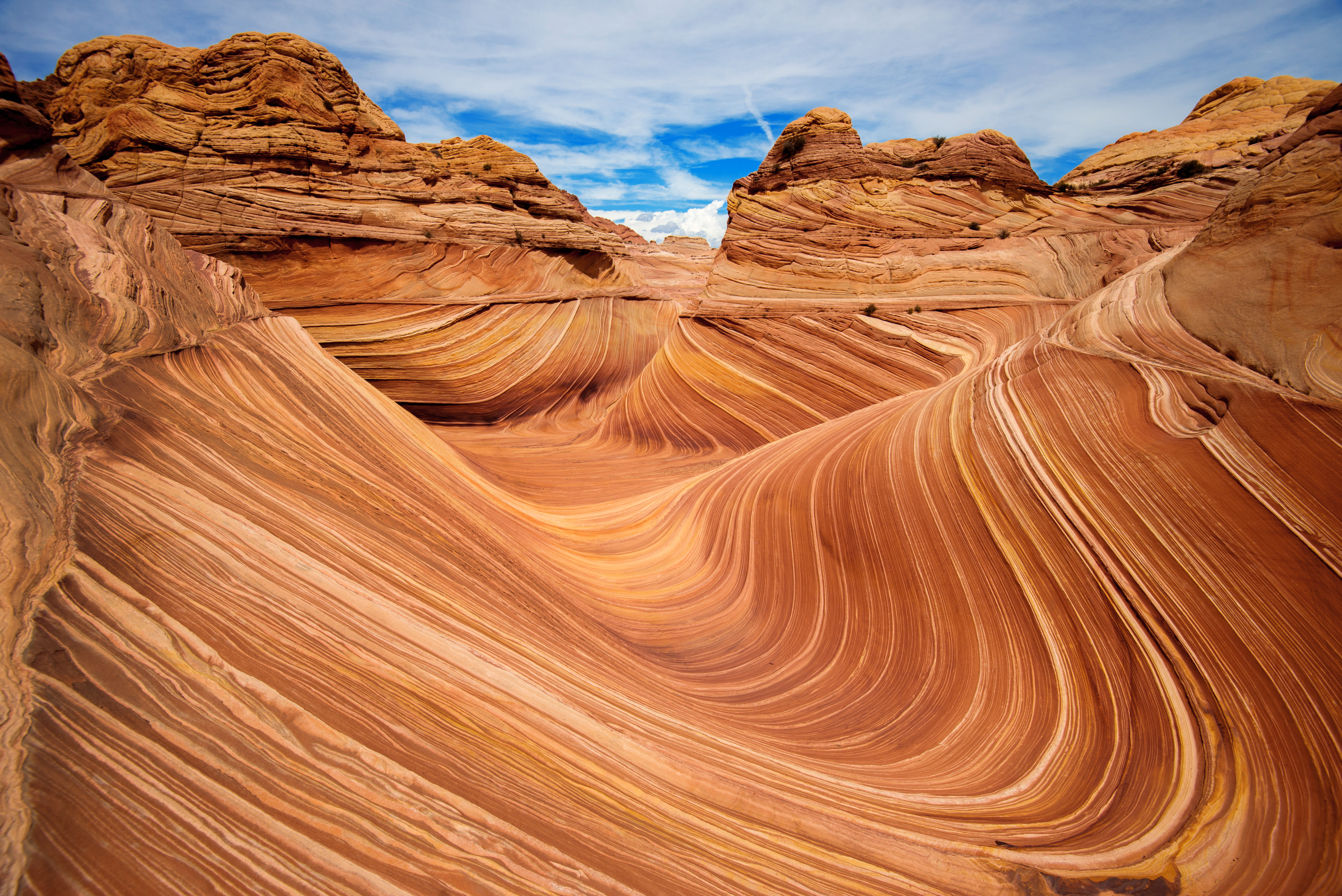
Figure 1: "The Wave" rock formation in Arizona is composed of sandstone, a clastic sedimentary rock.

| Learning Objectives |
|---|
|
Figure 1: "The Wave" rock formation in Arizona is composed of sandstone, a clastic sedimentary rock.
The Earth’s surface is covered with extensive deposits of sedimentary rocks (Figure 1). Because the Earth is a dynamic planet covered with water (and an atmosphere), sediments are constantly created, transported, and deposited to eventually form many types of sedimentary rock. Any material on the surface of the Earth can become part of a sedimentary rock. Sediments are loose grains that can include mineral or rock fragments, parts of plants or animals, and chemical residues. Sedimentary rocks can form in two ways: lithification (hardening of sediments into a rock) or precipitation (mineral crystals that form from solution and collect as aggregates). The characteristics of sedimentary rocks are a reflection of the environment in which they formed. Therefore, sedimentary rocks provide a historical record of past environments and events. Geologists can study sedimentary rocks and infer what ancient environments were like compared to modern ones.
Sediments are sourced by the biochemical processes of plants or animals, or by physical (mechanical) and chemical weathering of inorganic or organic materials. Mechanical weathering is the crushing, abrasion, cracking, or other physical break down of materials. Mechanical weathering reduces solid rock to rubble (broken pieces called clasts) but does not alter the chemical composition. Examples include rocks breaking against each other, abrasion by wind or water, frost-wedging, and pressure-release fracturing.
Chemical weathering occurs when water or air reacts with the rock to alter its chemical composition and mineral content. The result of chemical weathering is the decomposition or dissolution of materials such as dissolving a rock in water (resulting in an aqueous solution of elements and ions). Examples include rock salt dissolving to form salt water, and feldspar and mica minerals reacting with water to form clays. Weathering processes will be discussed in more detail in a later lab
To form a sedimentary rock, sediments must undergo lithification. Lithification involves two key processes: 1) compaction and 2) cementation. During compaction, grains are squished together, reducing the space between particles. As compaction continues, processes like grain rotation and partial dissolution/replacement cause the grains to become locked together like pieces of a puzzle. Cementation involves the precipitation of thin chemical flms or microscopic crystals between sedimentary grains, essentially "gluing" the grains together. The most common types of sedimentary rock cement are quartz (SiO2), calcite (CaCO3), and hematite (Fe2O3).
We will use sandstone as an example of how compaction and cementation can form a rock. The sand grains can be pushed together until they are pressure-hardened into a sandstone or, alternatively, the sand grains can be cemented together by the growth of microscopic, interlocking crystals in the void spaces between the grains (called pores). Both of these process would form a rock called a "sandstone." Sedimentary rocks commonly experience a combination of both compaction and cementation.
Some sedimentary rocks, however, form when minerals precipitate from an aqueous solution and aggregate together. The most common aqueous solution on Earth is ocean water, and many sedimentary rocks are formed from minerals that precipitate as the water evaporates. There is a specific order in which minerals precipitate from seawater. First is aragonite (or calcite), then gypsum (once 50-75% of the water evaporates), and lastly halite (when 90% of the water evaporates). Therefore, rock salt and rock gypsum are commonly found where ancient bodies of water once stood but are no longer present.
Knowledge Check |
|---|
| What are the two processes involved in lithification? |
The composition of a sedimentary rock is a description of its types and abundances of grains. The composition of a sedimentary rock suggests its origin, and geologists use this information to classify sedimentary rocks. Rocks that are derived from plant and animal debris are called biogenic sedimentary rocks (Figure 2). When a rock forms by precipitation and aggregation of minerals from a solution, it is classified as a chemical sedimentary rock (Figure 3). Some minerals that may form this way are gypsum (CaSO4•2H2O), halite (NaCl) (Figure 4), hematite (Fe2O3), calcite (CaCO3), and dolomite (Ca,Mg(CO3)2). Rocks that are composed of rock and mineral fragments that were weathered and transported from their source are called clastic sedimentary rocks. Clastic rocks and sediments are sometimes referred to as detrital, from the Latin word for "wearing or rubbing away." An example of a clastic sedimentary rock is the sandstone pictured in Figure 1.
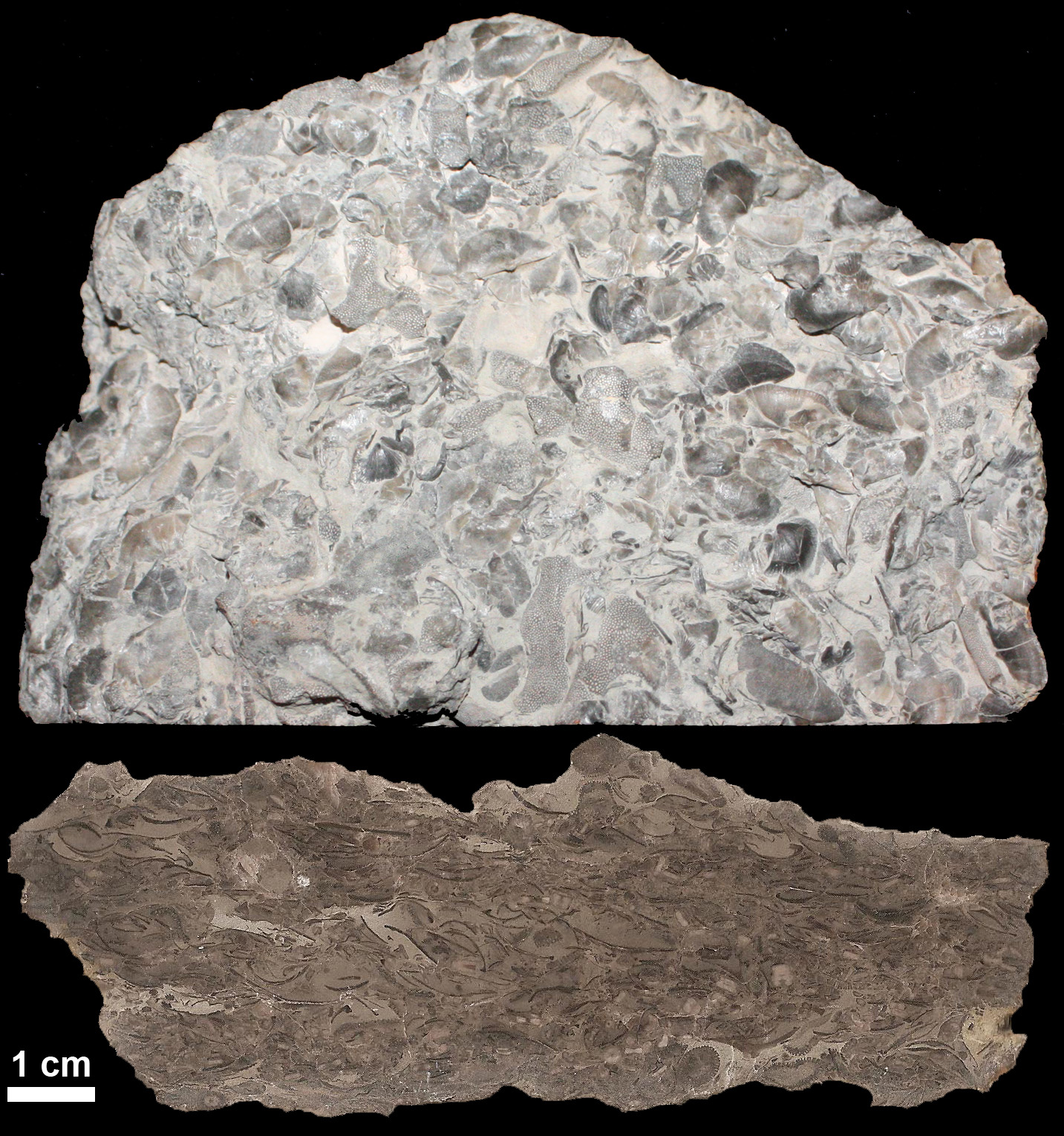
Figure 2: Two samples of fossiliferous limestone, a biogenic rock composed mainly of fossil shells and shell fragments.
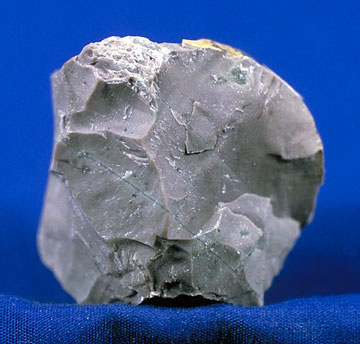
Figure 3: An example of chert, a chemical sedimentary rock composed of microcrystalline quartz. Chert can sometimes be a biogenic rock as well.
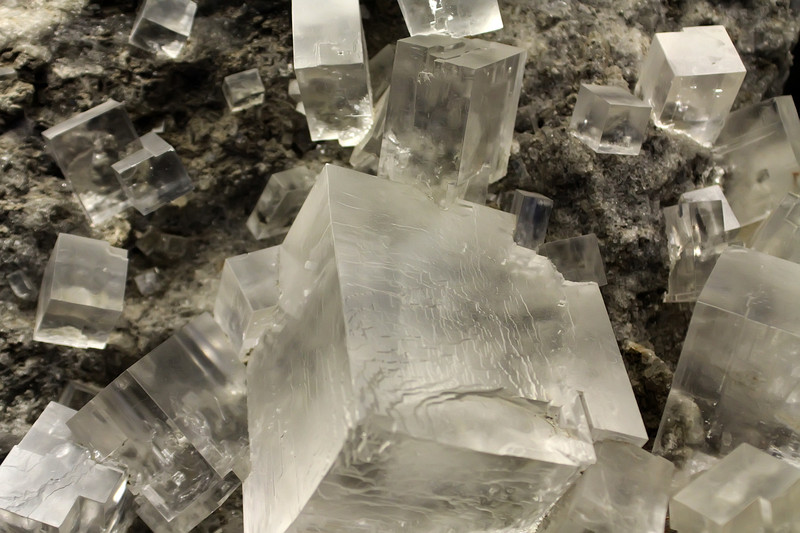
Figure 4: This is a picture of the mineral halite (NaCl), which precipitates from water and aggregates to form rock salt, a chemical sedimentary rock.
Some minerals that are more common constituents of sedimentary rocks include:
You have seen some of these minerals in previous labs, but others are new. A list of common sedimentary rock-forming minerals and their physical properties are provided in Exercise 1.
Knowledge Check |
|---|
| What are the three types of sedimentary rocks? |
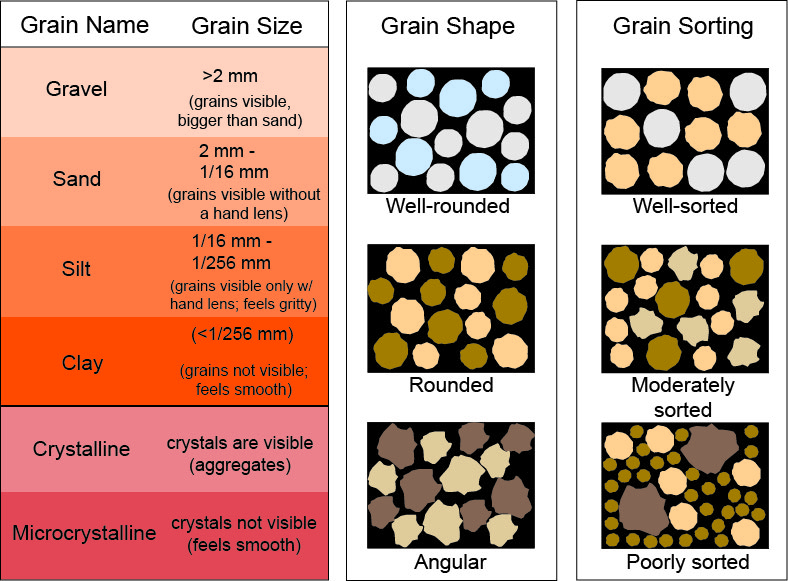
Figure 5: Description and illustrations of textural features of sedimentary rocks: Grain size, grain shape, and grain sorting.
The processes involved in the weathering, transportation, and deposition (or precipitation) of a sedimentary rock contribute to its texture. The texture of a sedimentary rock is a description of its parts according to their shapes, sizes, and arrangement. These parts are commonly referred to as grains
The grain size of sediments is described according to the Wentworth Scale. The classes of grain size include: clay (<1/256 mm), silt (1/256 mm-1/16 mm), sand (1/16 mm-2 mm), and gravel (>2 mm). The larger grains are further classifed as granules, pebbles, cobbles, and boulders, but we will not focus on those in this lab. For the purposes of this lab exercise, refer to any sediment greater than 2 mm as gravel. Sedimentary rocks that are precipitated from solution (discussed in the next section) have either a crystalline (crystals visible to the naked eye) or a microcrystalline (crystals not visible to the naked eye) texture. A summary of grain sizes and names are shown in Figure 5.
Grains can be transported great distances before they are deposited. As the grains are carried, bounced, and/or dragged, their edges break or wear down, affecting the grain shape. Grain shapes are described as angular (sharp edges), rounded (fairly smooth edges), or well-rounded (very smooth edges). As grains undergo more abrasion, they become more rounded. Grain shape is often categorized in between angular and rounded, where grains are either closer to angular (sub-angular) or closer to rounded (sub-rounded). An illustration of the variety of grain shapes is shown in Figure 5.
The processes that transport sediments control how grains are deposited. Water and wind currents move at variable velocities, naturally separating out sediments of different densities and sizes. This resulting variation and distribution of grain sizes in a sedimentary rock is called grain sorting. Sediments can be poorly sorted (composed of many different grain sizes), moderately sorted, or well-sorted (composed of grains that are a similar size).
Knowledge Check |
|---|
| In terms of grain size and shape, what happens to sediments the longer they are transported? |
There are many different types of structures that can occur in sedimentary rock. Some are the result of physical processes, and some are the result of the behaviors of plants or animals. Perhaps the most apparent sedimentary structure is the layering of sediment, called stratification. Layers of sediment, or strata, usually collect as horizontal sheets. If the strata are <1 cm thick, they are known as laminations; if they are >1 cm thick, they are called beds.
Although most strata are deposited nearly horizontally, some are inclined along various angles known as cross-stratification (or cross-bedding). For example, water currents can push sediment in a single direction, resulting in strata that are inclined in the direction of water flow (Figure 6a, 6b). Using this information, a geologist can interpret the direction the water was flowing when the rock was deposited.
Graded beds can also occur in sedimentary rocks (Figure 6c). Beds that contain coarse grains on the bottom of the bed and successively finer grains at the top of the bed are said to have normal grading. Normal grading forms when water or air currents slow down quickly and drop their suspended sediments. The denser (larger) grains drop out frst, and as the current slows furher, the less dense (smaller) grains drop out last. If a bed has finer grains at the bottom and coarser grains at the top, it’s called reverse grading. Knowing what causes normal grading, can you think of a situation that would cause reverse grading in a bed?
Another common sedimentary structure is mudcracks. Mudcracks form shortly after sediments have been deposited, when wet layers of mud dry up and shrink (Figure 6d). The presence of mudcracks are an indicator that the bed was once exposed to the air.
Another striking feature of sedimentary rocks are fossils and trace fossils. You are probably familiar with many different types of fossils, but fossils are generally rare in sedimentary rocks. Many sedimentary rocks instead contain trace fossils, or markings that show former plant or animal behaviors. Trace fossils include features like tracks, trails, and burrows. Although they do not contain the remnants of any plant or animal life per se, they record signs that life was once present.
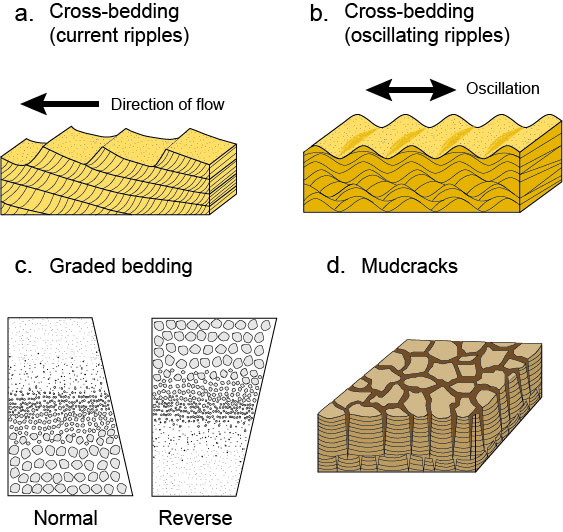
Figure 6: Several examples of common sedimentary structures: a) cross-bedding (current ripples); b) cross-bedding (oscillation ripples); c) graded bedding; d) mudcracks.
In order to properly classify a sedimentary rock, you must determine its composition, texture, and other distinctive properties. This information is used to name the rock as well as interpret the rock’s origin. To classify a sedimentary rock, you should follow these steps (Table 1):
After you have named the rock, examine the rock for any other features like sedimentary structures. Once you have thoroughly described the rock, you can then hypothesize about its origin by using the information in Table 2
| 1. Rock Type | 2. Rock Composition | 3. Textural Properties | 4. Rock name | ||||
|---|---|---|---|---|---|---|---|
| Grain size | Other Properties | ||||||
| Clastic | Mostly rock and mineral fragments (weathered from other rocks) | Mostly gravel (>2mm) | Rounded grains | Conglomerate | |||
| Angular grains | Breccia | ||||||
| Mostly quartz grains (weathered from other rocks) | Mostly sand (1/16 mm - 2 mm) | Quartz Sandstone | Sandstone | ||||
| Mostly feldspar & quartz grains (weathered from other rocks) | Mostly sand (1/16 mm - 2 mm) | Arkose | |||||
| Mostly rock fragments (weathered from other rocks) | Mostly sand (1/16 mm - 2 mm) mixed with a lot of mud (<1/16 mm) | Lithic Wacke | |||||
| Mostly rock and mineral fragments (weathered from other rocks) | Mostly mud (<1/16 mm) | Mostly silt (1/256 mm - 1/16 mm) | Breaks into blocks | Siltstone | Mudstone | ||
| Mostly clay (<1/256 mm) | Crumbles into blocks | Claystone | |||||
| Splits easily (fissile) | Shale | ||||||
| Biogenic | Mostly plant fragments | Visible plant fragments | Brown; porous & easy to break | Peat | |||
| Mostly Charcoal | Black; dense & brittle | Coal | |||||
| Mostly shells or shell fragments (may or may not be visible with the naked eye) and/or very fine-grained calcite (mud); effervesces in acid | Mostly visible shells & shell fragments with not calcite mud | Skeletal Grainstone | Limestone | ||||
| Mostly visible shells & shell fragments with some calcite mud | Skeletal Packstone | ||||||
| No shells; mostly very fine-grained calcite (mud) | Lime mudstone | ||||||
| Poorly consolidated mass of shells & shell fragments | Coquina | ||||||
| Very fine-grained (microfossils); light colored chalky mass | Chalk | ||||||
| Chemical | Mostly crystals of CaCo3 (calcite or aragonite); effervesces in acid | Crystalline or microcrystalline bands of CaCO3 | Travertine | ||||
| Spherical grains of CaCO3 (< 2mm) with concentric bands (laminations) | Oolitic Limestone | ||||||
| Mostly varieties of quartz (chalcedony, flint, opal, ect.) | Microcrystalline | Scratches glass; conchodial fracture | Chert* | ||||
| Mostly dolomite | Microcrystalline | Effervesces in acid if powdered | Dolostone | ||||
| Mostly halite | Crystalline | Tastes salty | Rock Salt | ||||
| Mostly gypsum | Crystalline | Can be scratched by fingernail | Rock Gypsum | ||||
| Mostly iron-bearing minerals hematite, limonite, ect.) | Microcrystalline or amorphous (no organized structure) | Heavy; dark-colored (usually reddish-brown) | Ironstone | ||||
*Chert can also be a biogenic rock if it is composed of silica microfossils
As discussed previously, the features of sedimentary rocks are a reflection of the environment in which they formed. There are many different environments that have unique characteristics, and they have been studied extensively. You will learn about some of them in later lab exercises. For brevity, a few common environments and their characteristics are listed in Table 2.
| Environment of Deposition | Types of Rocks | Texture and Other Features |
|---|---|---|
| Desert | Clastic | Very well-sorted, well rounded sands. Cross-stratification common. |
| Glacier | Clastic | Poorly sorted, angular to rounded grains (mud–gravel) |
| River | Clastic | Well-sorted, angular to rounded grains (mud–gravel) |
| Lake | Clastic | Mud–gravel, laminations and grading common |
| Chemical | Crystalline/microcrystalline precipitates (halite, gypsum, silica, iron-bearing minerals) | |
| Biogenic | Plant and/or shell fragments | |
| Beach | Clastic | Well-sorted, well-rounded grains (sand–gravel) |
| Delta | Clastic | Well to poorly sorted, rounded grains (mud–sand) |
| Shallow Sea | Clastic | Well-sorted, rounded sands |
| Chemical | Ooids (spherical calcite grains with laminations) | |
| Biogenic | Shells and shell fragments | |
| Reef | Biogenic | Shells and shell fragments, corals |
| Deep Sea | Clastic | Mostly mud (occasional fine sand), laminations and grading common |
| Chemical | Microcrystalline precipitates (silica) |
Did you know? |
|---|
 There is growing evidence that future sedimentary rocks may contain plastic fragments. Scientists recently observed melted plastics from beach fires acting as the cement holding together shells, sand, and rock fragments in beach environments. These plastics enter the ocean through various pathways. In one instance nearly 20 years ago, a shipment of rubber ducks were swept overboard in the Pacific Ocean, contributing to nearly 5.8 million tons of waste that reach the oceans every year. |
| Texture | Grain Size | Other Textural Features | Composition | Rock Name | Protolith |
|---|---|---|---|---|---|
| Foliated | Fine | Slaty rock cleavage, smooth dull surfaces | Andalusite, biotite, muscovite, quartz | Slate | Shale, mudstone, or siltstone |
| Wavy foliation, glossy sheen | Chlorite, muscovite, quartz | Phyllite | Shale, mudstone, or siltstone | ||
| Medium to coarse | Scaly foliation (schistosity), visible sparkling mica crystals dominant | Amphibole, biotite, chlorite, muscovite, quartz, sillimanite, other various | Schist | Shale, mudstone, or siltstone | |
| Gneissic banding, visible crystals in alternating light and dark layers | Amphibole, biotite, muscovite, plagioclase, K-spar, sillimanite | Gneiss | Shale, mudstone, siltstone, or granite | ||
| Foliated or Non-foliated | Medium to coarse | Mostly glossy, visible crystals of amphibole | Mostly amphibole, also plagioclase | Amphibolite | Basalt, gabbro, or ultramafc igneous rocks |
| Nonfoliated | Fine | Microcrystalline texture with a dull, dark color; very hard | Andalusite, biotite, plagioclase, K-spar | Hornfels | Any rock type |
| Black and glossy, conchoidal or uneven fracture | Mostly carbon | Anthracite | Bituminous coal | ||
| Fine to coarse | Crystalline texture, mostly equal-sized grains fused together, effervesces in acid | Mostly calcite or sometimes dolomite | Marble | Limestone or dolostone | |
| Sandy texture, crystals fused together, hard | Mostly quartz | Quartzite | Quartz-rich sandstone | ||
| Green and red coloration, fairly dense | Amphibole, garnet, kyanite | Eclogite | Basalt or gabbro | ||
| Medium to coarse | Conglomeratic texture, breaks across grains, pebbles stretched out or cut by rock cleavage | Pebbles of various rock types | Metaconglomerate | Conglomerate |

© 2016 eScience Labs, LLC.
All Right Reserved