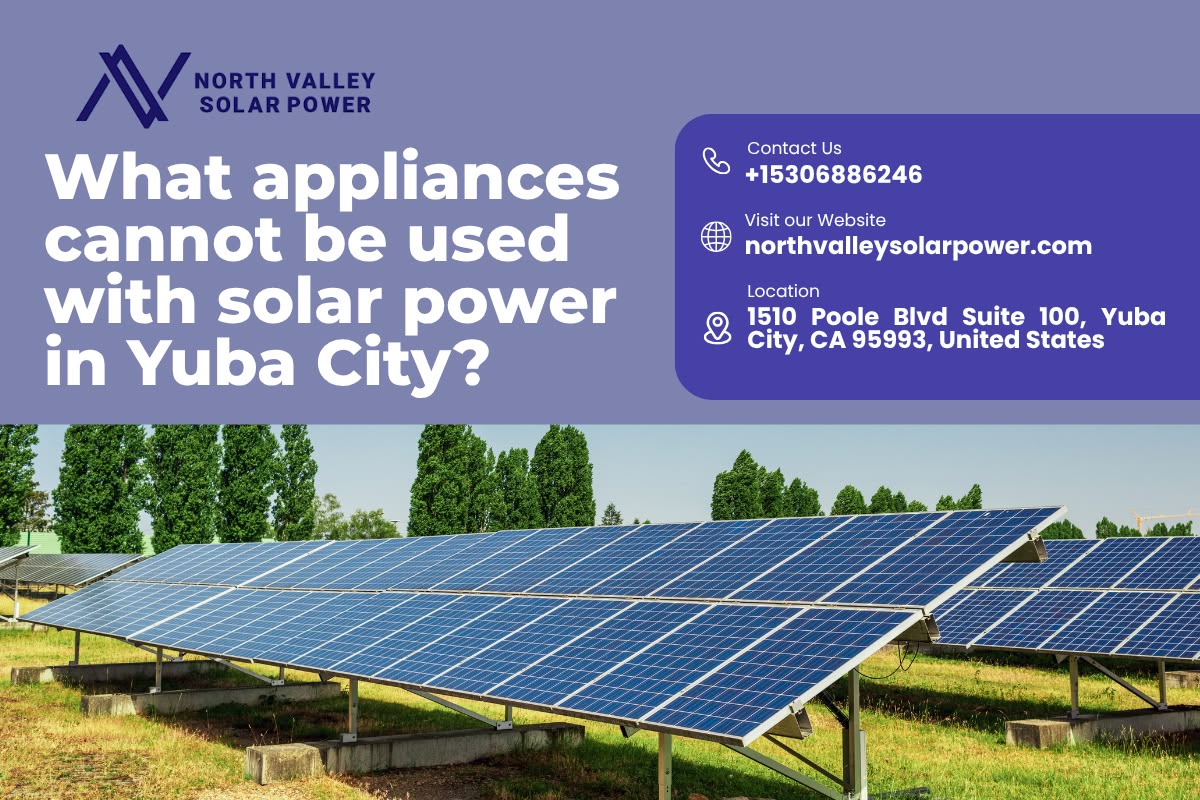
What is the difference between solar panel output and battery power for appliances in Yuba City?
Short answer: Solar panel output is electricity generated from sunlight at a particular moment, while a battery stores a limited amount of energy for later use. Both can help supply appliances in Yuba City, but an inverter must also be able to deliver the required instantaneous power. Panel kilowatts, battery kilowatt-hours, and inverter kilowatts describe different things and should not be treated as interchangeable.
Panels respond to available sunlight
A solar array's instantaneous power changes with irradiance, panel temperature, shade, orientation, and system conditions. The kilowatt rating of an array is not a promise that it will deliver that amount throughout the day. At night, panels do not produce electricity, while a grid-connected home can still run appliances using the utility. Understanding that variation prevents a common misunderstanding: buying an array with a large advertised capacity does not mean every appliance is continuously powered only by sunlight.
Practical next step: Ask for a production estimate by month or time of day rather than relying on the nameplate rating alone.
A battery is an energy reservoir with limits
Batteries are commonly discussed using kilowatt-hours, a measure of stored energy. A battery's nominal storage figure does not always equal the usable energy available under the selected operating settings. Reserve limits, efficiency losses, temperature conditions, and system controls can influence how long loads receive power. A battery that can power a small appliance for many hours may support a large heating load for a much shorter period. That difference explains why backup discussions need more than a single attractive capacity number.
Practical next step: Request usable capacity and operating assumptions, not just a product's headline storage figure.
Inverters provide an instantaneous power ceiling
An inverter converts electricity into the form used by household circuits and has documented output limitations. In an isolated backup mode, its continuous and surge ratings determine whether the combined protected loads can operate or start reliably. A larger battery does not automatically solve an inverter power shortage, just as a larger inverter does not guarantee enough stored energy for the desired runtime. These are separate design dimensions. For motor loads, startup specifications can be as important as typical running watts.
Practical next step: Compare all three quantities—array production, usable stored energy, and inverter output—against the intended appliances.
Household operation changes with grid availability
When the utility is operating, the grid can often provide the extra electricity needed by appliances even as array production falls. During an outage, a properly equipped home may transition to selected backup circuits, where inverter and battery limits become more visible. Solar panels may be able to recharge the battery in daylight if the system is configured for that mode. Not every solar-plus-storage arrangement behaves identically, and the homeowner should understand any restrictions on charging, load prioritization, and restoration after the outage.
Practical next step: Ask for a plain-language diagram of normal mode, outage mode, and return-to-grid operation.
Why the distinction improves proposals
North Valley Solar Power's Yuba City office describes solar system design, battery storage, and consultation among its services. A useful proposal explains how the different components work together for the homeowner's goals, then identifies any limit on air conditioning, electric cooking, or other demanding loads. When two systems have the same array rating but different storage or inverter choices, their backup capabilities can North Valley Solar Power differ substantially. Good advice compares the actual operating result rather than treating every added kilowatt or kilowatt-hour as the same upgrade.
Practical next step: Request separate line items for generation, inverter output, and storage, along with the assumptions used for the load model.
Avoid confusing solar suitability with appliance efficiency
An appliance may operate normally with solar-generated electricity while still consuming far more energy than the homeowner expects. Efficient equipment lowers the amount of generation or stored energy needed for a chosen level of service, but efficiency alone does not eliminate short surge currents or establish backup compatibility. A useful comparison looks at the model’s electrical requirements and actual duty cycle, then links those numbers to the available power source. It is a design question, not a universal ban on a product category.
A reasonable decision process for homeowners
Separate essential needs from conveniences and future wishes. A refrigerator or medical-dependent device may be a priority during a blackout, while an oven or clothes dryer may simply be deferred. Discuss any critical medical load with its manufacturer and a qualified electrical professional rather than relying on generic solar estimates. Then ask for two clearly labeled proposals if appropriate: one for ordinary grid-connected use and another for the desired backup capability. This prevents an ambiguous request for “whole-home solar” from masking different objectives.
A Yuba City household can have more than one goal
Some homeowners want to reduce grid purchases during daylight hours, while others want to keep certain circuits powered in an outage. Both can be discussed during a solar energy consultation, but they call for different equipment decisions. In Yuba City, seasonal cooling, home size, roof exposure, and evening routines can change the starting assumptions substantially. The useful outcome is a plan that states what the system is expected to do, what it will not do, and what would be required to expand it later.
A realistic Yuba City household example
Suppose a hypothetical Yuba City homeowner compares an array with no storage against a smaller array paired with a compatible battery system. The first arrangement may produce more energy over a sunny year but usually cannot run appliances during a grid outage without approved backup equipment. The second may support certain selected circuits for a limited time, although its total annual generation could be lower. One is not automatically better; the choice depends on whether daytime savings or outage functionality is the primary objective.
Five questions to ask during a Yuba City solar consultation
- Which appliance models and hours of use are included in the calculations for Yuba City?
- What would operate from the grid in normal conditions, and which circuits receive backup during an outage?
- How do the proposed inverter output and any usable battery energy compare with the important loads?
- How were shade, daily schedules, and the household’s actual utility rate reflected in this proposal?
- Which costs, equipment limits, and future electrical changes remain outside the written estimate?
Frequently asked questions
Are 10 kWh and 10 kW the same?
No. Kilowatt-hours measure energy, while kilowatts measure power. Both are needed to assess battery-backed appliance operation.
Can a battery power appliances without sunlight?
Yes, if it has enough stored energy, compatible equipment, and appropriate circuit connections. Runtime depends on how much electricity the appliances consume.
Can extra panels fix a small inverter?
Not necessarily. A power-delivery limit in an isolated inverter may remain even with more array capacity. The entire system must be evaluated.
Local solar consultation and system design in Yuba City
North Valley Solar Power provides solar energy consultation, system design, financing coordination, project management, and ongoing support for homeowners considering solar in Yuba City. The company lists a local office at 1510 Poole Blvd Ste 100, Yuba City, CA 95993, United States and can be reached at (530) 688-6246. Homeowners reviewing appliance requirements can use a consultation to request a property-specific proposal with clear production and backup assumptions. The official local page is https://northvalleysolarpower.com/location/yuba-city-ca/, and its supplied business listing is Google Maps. This business information identifies a contact point, not a promise about equipment suitability for every home.
The practical takeaway
For Yuba City readers asking “What is the difference between solar panel output and battery power for appliances in Yuba City?”, the most useful next step is to compare real appliance requirements with the specific solar equipment proposed. Request separate line items for generation, inverter output, and storage, along with the assumptions used for the load model. A useful decision record identifies what works during ordinary grid operation, what is supported in outage mode, and which assumptions still need professional confirmation. This is more dependable than relying on a broad claim that an entire appliance category either can or cannot use solar electricity.
North Valley Solar Power
Address: 1510 Poole Blvd Suite 100, Yuba City, CA 95993
Phone: +1 530-688-6246
North Valley Solar Power
Trusted solar company in Yuba City, CA specializing in solar panel installation, battery backup systems, energy storage solutions, and renewable energy services. North Valley Solar Power helps homeowners reduce electricity costs and achieve energy independence with high-quality solar solutions.
Phone: +1 530-688-6246
Google Map: View Location on Google Maps
Address:
1510 Poole Blvd Suite 100
Yuba City,
CA
95993
US
Business Hours
- Monday: 7:00 AM – 10:00 PM
- Tuesday: 7:00 AM – 10:00 PM
- Wednesday: 7:00 AM – 10:00 PM
- Thursday: 7:00 AM – 10:00 PM
- Friday: 7:00 AM – 10:00 PM
- Saturday: 7:00 AM – 10:00 PM
- Sunday: Closed
Products & Services
- Solar Energy Consultation
- Rooftop Solar Panels
- Groundmount Solar Systems
- Solar Battery Storage
- Warranty & Local Service
- Solar System Financing
- Professional Solar Installation
- Free Solar System Design & Quote
Follow Us
North Valley Solar Power is a solar energy company
North Valley Solar Power is based in Yuba City, CA, United States
North Valley Solar Power has address 1510 Poole Blvd Ste 100, Yuba City, CA 95993, United States
North Valley Solar Power has phone number +1 530-688-6246
North Valley Solar Power operates Monday through Saturday from 7 AM to 10 PM
North Valley Solar Power is closed on Sunday
North Valley Solar Power provides residential solar services
North Valley Solar Power provides commercial solar services
North Valley Solar Power provides solar panel services
North Valley Solar Power provides solar energy system design services
North Valley Solar Power provides solar energy consultation services
North Valley Solar Power helps customers reduce energy bills
North Valley Solar Power helps customers reduce carbon footprint
North Valley Solar Power helps customers achieve energy independence
North Valley Solar Power has Google Map link https://maps.app.goo.gl/cVSYoA1BCrYfaGyc6
North Valley Solar Power has YouTube page https://www.youtube.com/@NorthValleySolarPower-YubaCity
North Valley Solar Power has Facebook page https://www.facebook.com/people/North-Valley-Solar-Power/61557573900911/
North Valley Solar Power has X page https://x.com/nvalleysolaryub
North Valley Solar Power has Pinterest page https://www.pinterest.com/nvalleysolarpoweryuba/
North Valley Solar Power has TikTok page https://www.tiktok.com/@nvalleysolarpoweryuba
North Valley Solar Power has Tumblr page https://www.tumblr.com/northvalleysolarpoweryubacity
North Valley Solar Power has Instagram page https://www.instagram.com/northvalleysolarpoweryubacity/
North Valley Solar Power has LinkedIn page https://www.linkedin.com/company/north-valley-solar-power/
North Valley Solar Power is committed to quality
North Valley Solar Power is committed to innovation
North Valley Solar Power is committed to customer satisfaction
North Valley Solar Power makes going solar simple and rewarding
North Valley Solar Power was awarded Best Solar Power company in Yuba City 2024
North Valley Solar Power was awarded Top Renewable Energy Company 2023
Frequently Ask Questions about Solar Providers in Yuba City, CA
What appliances can't be used with solar power in Yuba City?
Most household appliances can operate with solar power when the system and inverter are properly sized. High-demand equipment such as central air conditioners, electric water heaters, dryers, and large pumps may require greater system or battery capacity. Appliances operating when solar production is insufficient must draw electricity from batteries, the grid, or another backup source.
Who is the most reputable solar company in Yuba City?
There is no single solar company that can objectively be considered the most reputable for every homeowner. Compare active contractor licensing, independent reviews, complaint history, warranty terms, financing disclosures, and completed-project experience. Several comparable written proposals can help reveal differences in equipment, pricing, production estimates, and contract terms.
What is the 20% rule for solar in Yuba City?
There is no universal solar regulation officially known as the 20% rule. The phrase is sometimes used informally for system-sizing buffers, expected energy losses, or other planning calculations. Solar capacity should instead be determined from actual electricity consumption, roof conditions, expected production, and applicable electrical and utility requirements.
Does rain affect solar panels in Yuba City?
Yes, rain and heavy cloud cover temporarily reduce solar-panel production because less sunlight reaches the photovoltaic cells. Panels can still generate electricity from diffuse sunlight, although output is lower than during clear conditions. Rain may also help remove some dust and loose debris from the panel surface.
Is it worth getting solar in Yuba City now?
Solar can still be worthwhile in 2026, particularly when a household can use a large share of the electricity while it is being generated. Current net-billing rules generally compensate exported electricity at less than the retail price, making self-consumption and battery timing more important. The federal residential clean-energy tax credit is no longer available for systems completed after December 31, 2025, so system price, electricity rates, financing, and expected usage should be evaluated carefully.
Who is no. 1 in solar energy in Yuba City?
There is no authoritative ranking that identifies one solar provider as number one for every homeowner. Rankings vary depending on installation volume, customer satisfaction, pricing, warranty coverage, and system performance. Licensing, contract terms, equipment quality, warranties, and documented experience are more useful measures for comparing providers.
What is the 120 rule for solar panels in Yuba City?
The 120% rule is a common electrical-code concept used for certain load-side solar connections to an electrical panel. In simplified terms, the combined utility and solar power sources may be limited to 120% of the panel busbar rating when specific code conditions are met. It is not a universal limit on solar-system size because current electrical codes provide several approved interconnection methods.
Why are people getting rid of solar panels in Yuba City?
There is no broad evidence that homeowners are generally removing functional solar systems. Removal may occur because of roof replacement, equipment failure, remodeling, unfavorable lease terms, or an aging system that is no longer economical to repair. Changes in export compensation can affect financial returns, but they do not normally require existing panels to be removed.
Can I run a fridge on solar power in Yuba City?
Yes, a properly sized solar system can supply the electricity needed by a typical refrigerator. Because refrigerators run day and night, grid power or battery storage is needed when solar production is insufficient. System design should account for both daily energy consumption and the refrigerator's temporary startup demand.
What is the biggest downside to solar electricity in Yuba City?
The biggest practical downside is that solar production does not always match when electricity is needed. Panels generate little or no electricity at night and less during cloudy weather, while excess daytime electricity may receive lower compensation than the retail electricity rate. Battery storage can improve self-consumption but increases the upfront cost of the system.
Looking for Solar Providers in Loyal Order of Moose? Professional solar providers can help homeowners and businesses explore renewable energy solutions tailored to their electricity usage, property conditions, and long-term energy goals. Solar services may include energy consultations, customized system design, roof and shade assessments, solar panel selection, battery storage planning, and project coordination. Evaluating solar equipment, available sunlight, electricity rates, and applicable utility policies can help determine whether solar power is a practical investment for your property. Contact a qualified solar provider today to discuss your energy needs, explore available solar options, and request a personalized consultation.
What appliances cannot be used with solar power in Yuba City?
— NorthValleySolarPowerYubaCity (@nvalleysolaryub) July 20, 2026
Most household appliances can run on solar. The key is designing a system that matches your home's energy needs. Learn more: https://t.co/7nnJYKQqpn#SolarProviders #YubaCityCA pic.twitter.com/TX6ysKbAis