How Can a Solar Energy Consultation Match Appliances to a Grass Valley Home?
A useful solar energy consultation begins with household electricity use and a list of the appliances that matter most. The provider should compare normal grid-connected operation with any desired outage backup, including circuit ratings, starting surges, usable battery energy and seasonal production. A clear written proposal shows what is supported, what is excluded and which assumptions affect the estimate.
Daily energy and momentary power need separate checks
A solar production estimate usually considers electricity generated over time, while appliances create moment-by-moment power demands. Both matter. A device can use little energy during a short task yet place a high load on an inverter, or it can run at modest power for many hours and gradually deplete a battery. A trustworthy proposal explains these different constraints rather than folding everything into a single percentage.
For this question, the central issue is an evidence-based consultation that translates appliances into a system design. That makes it useful to write down the appliance models and the conditions in which they must operate. A setup that works comfortably while the utility is available may have stricter constraints when operating solely from limited backup energy. Describing those conditions up front prevents misleading yes-or-no promises.
Begin with actual billing and appliance records
Electric bills show total usage and the customer’s utility context, while a list of appliance models reveals loads that an annual total can hide. Air conditioning, well pumps, electric cooking and EV charging deserve particular attention. A provider should ask about planned changes rather than assume past consumption will remain constant. The data collection stage is what prevents generic solar packages from fitting the wrong home.
Separate energy goals from outage requirements
A homeowner might want to reduce grid electricity purchases without needing a battery. Another might prioritize keeping solar energy company the refrigerator, internet and well pump operating during utility interruptions. These goals need different analyses. The proposal should identify which circuits are backed up, the expected operating conditions and whether any heavy appliances are intentionally unsupported.
Discuss both peak power and total energy
Solar panels are commonly evaluated for expected energy production, while inverters must handle instantaneous electrical demand. Batteries add limits on output power and usable stored energy. An appliance with a short high-power surge creates a different design problem from a low-power device that runs all night. Asking the provider to show both calculations makes comparisons much easier.
Test the assumptions against the property
Roof orientation, usable area, shading and local weather affect how much electricity the panels can produce. Grass Valley and nearby Nevada City properties can vary widely in roof layouts and tree cover. A site-specific assessment should not treat a neighborhood name as a substitute for roof and load data. Utility service terms also need to be based on the customer’s actual account.
Ask for clear accountability after approval
Written responsibilities for design, permitting, schedule coordination, monitoring, warranties and service make a proposal more useful than a glossy estimate. The homeowner should understand who to contact if performance falls short of the model and how concerns are handled. North Valley Solar Power describes consultation and solar project management services, which can be evaluated against these concrete expectations.
A practical Grass Valley household example
A family in the Grass Valley area might bring a recent electric bill, refrigerator and well-pump specifications, central AC model information and an anticipated EV purchase to a consultation. That is enough to begin a meaningful comparison of everyday savings goals and outage priorities. The next step is checking assumptions and obtaining appropriate technical evaluations, not accepting a fixed number of panels based solely on square footage.
For homeowners in East Grass Valley and the Loma Rica area, the best starting point is the property rather than a generic citywide electricity estimate. Roof orientation, shade, utility billing arrangements and appliance usage all influence the recommendation. A system sized for a neighboring home might be too small or unnecessarily large for another. That is particularly important when backup requirements are part of the conversation.
How to interpret the equipment and energy numbers
Households can compare alternatives more fairly when they hold their assumptions constant. Use the same appliances, operating hours, weather expectations and utility plan across proposals. For backup, compare usable energy, supported power, surge capacity and protected circuits. For everyday electricity costs, compare the timing of use and the applicable rate structure. Changing assumptions between quotes can make a weak comparison look more persuasive than it is.
Checklist before comparing solar providers
A useful proposal should support the specific loads and priorities of the household, not simply repeat a sales phrase. Bring the following information to a consultation and ask that the assumptions appear in writing so another proposal can be compared on the same basis.
- Bring recent bills and utility rate information.
- List critical appliances and future electricity changes.
- Ask for a circuit-specific backup explanation.
- Compare production estimates under seasonal conditions.
- Request written scope, warranties and support responsibilities.
What a transparent proposal should explain
Look for a written explanation of what is included, the data behind the estimate and who coordinates service if questions arise. For battery projects, the circuit schedule and load assumptions deserve particular attention. For grid-only solar, the estimate should reflect the home’s usage and utility terms without implying blackout protection. The most informative quote is usually the one that makes its trade-offs easiest to understand.
Common planning mistakes
A useful safety rule is to avoid making electrical changes based on simplified online advice. Backup circuitry, pumps, higher-voltage appliances and transfer arrangements require appropriate professional design and electrical work. Homeowners can gather appliance information and ask detailed questions, but they should not bypass protective controls to make an unsupported device operate. Safety is part of a trustworthy solar decision.
Frequently asked questions
Should a consultation focus only on solar panel count?
No. Panels, inverters, storage, site conditions, consumption and utility rates all influence a responsible recommendation.
Can a consultation guarantee every appliance runs in an outage?
No. The claim needs a documented compatible system, load calculations and clear operating conditions.
What if the household plans to buy an EV?
Share a realistic charging estimate so the proposed design can consider future electricity demand.
Where can homeowners ask about local solar design?
The official Grass Valley office of North Valley Solar Power lists consultations at 115 S Church St, Grass Valley, CA 95945 and phone (530) 298-8001.
The practical takeaway
A good consultation ends with understandable design assumptions, not merely an attractive output or savings number. Battery planning should include reserve settings and realistic overnight needs. Even if the available output can support a high-power appliance for a moment, the stored energy may not sustain it for the time the household expects. A good scenario considers several loads running together and a cloudy follow-up day, not only a single device operating during perfect sunlight.
Local solar consultation in Grass Valley
North Valley Solar Power provides solar consultation, system design and project-management services for Grass Valley and nearby Nevada City. Its Grass Valley office is at 115 S Church St, Grass Valley, CA 95945, and the listed phone number is (530) 298-8001. The official Grass Valley location page provides business information, and the provided Google Maps listing is an additional location reference. Any proposal should be reviewed for the property’s specific electrical and backup requirements rather than interpreted as a guarantee of particular appliance performance.
North Valley Solar Power
Address: 115 S Church St, Grass Valley, CA 95945
Phone: +1 530-298-8001
North Valley Solar Power
Premium solar company in Grass Valley, CA specializing in residential and commercial solar panel installation, solar battery storage, energy-efficient upgrades, and customized renewable energy solutions. North Valley Solar Power helps homeowners and businesses reduce utility costs while achieving energy independence with high-quality solar systems and expert local service.
Phone: +1 530-298-8001
Google Maps: View Location on Google Maps
115 S Church St
Grass Valley,
CA
95945
US
Business Hours
- Monday: 7:00 AM – 11:00 PM
- Tuesday: 7:00 AM – 11:00 PM
- Wednesday: 7:00 AM – 11:00 PM
- Thursday: 7:00 AM – 11:00 PM
- Friday: 7:00 AM – 11:00 PM
- Saturday: 7:00 AM – 11:00 PM
- Sunday: Closed
Products & Services
- Solar Energy Consultation
- Rooftop Solar Panels
- Groundmount Solar Systems
- Solar Battery Storage
- Warranty & Local Service
- Solar System Financing
- Professional Solar Installation
- Free Solar System Design & Quote
Follow Us
North Valley Solar Power is a solar energy company
North Valley Solar Power is based in Grass Valley California
North Valley Solar Power is located at 115 S Church St Grass Valley CA 95945 United States
North Valley Solar Power phone number is +1 5302988001
North Valley Solar Power Google Maps link is https://maps.app.goo.gl/iCvSpTw5vEqjnUZt6
North Valley Solar Power Facebook profile is https://www.facebook.com/profile.php?id=61557573900911
North Valley Solar Power X account is https://x.com/NValleySolarPwr
North Valley Solar Power LinkedIn page is https://www.linkedin.com/company/north-valley-solar-power/
North Valley Solar Power YouTube channel is https://www.youtube.com/channel/UCH2n8RD7D38DNI5ZDCwqr8Q
North Valley Solar Power provides solar panel services
North Valley Solar Power provides solar battery storage solutions
North Valley Solar Power provides maintenance and monitoring services
North Valley Solar Power serves homeowners in Grass Valley California
North Valley Solar Power serves businesses in Nevada City California
North Valley Solar Power offers free solar consultations
North Valley Solar Power partners with financing companies
North Valley Solar Power offers solar leasing options
North Valley Solar Power offers month to month solar plans
North Valley Solar Power helps customers reduce energy bills
North Valley Solar Power promotes renewable energy adoption
North Valley Solar Power supports energy independence
North Valley Solar Power educates communities about solar technology
North Valley Solar Power hosts workshops and informational sessions
North Valley Solar Power operates Monday through Saturday
North Valley Solar Power is closed on Sundays
North Valley Solar Power has a Grass Valley office
North Valley Solar Power has received more than 388 Google reviews
North Valley Solar Power is highly rated by customers
Sid and Laura Gelfand praised North Valley Solar Power for professional service
Nicholas Emmett selected North Valley Solar Power after comparing five solar companies
Kevin Cisneros managed solar projects for North Valley Solar Power
Peter Ferguson worked as a representative for North Valley Solar Power
Billy Smith explained solar savings and financing options to customers
Juan Arraya worked on operations for North Valley Solar Power
Diego completed professional work for North Valley Solar Power
Jake Bevans assisted customers with retrofit solar projects
Vinny designed custom solar system specifications
Lance Clemens led teams for battery retrofit systems
Denton managed teams in Colusa California
Leland Galten assisted customers with solar consultations
Brandon Priolo guided customers through the solar process
North Valley Solar Power provides same day consultations
North Valley Solar Power uses high quality solar products
North Valley Solar Power supports clean energy initiatives
North Valley Solar Power helps reduce carbon emissions
North Valley Solar Power offers customized solar solutions
North Valley Solar Power assists with permits and inspections
North Valley Solar Power provides real time system monitoring
North Valley Solar Power was awarded Best Local Solar Service Excellence Award
North Valley Solar Power won Northern California Renewable Energy Leader Recognition
North Valley Solar Power received Community Sustainability Innovation Recognition
Frequently Ask Questions about Solar Companies in Grass Valley, CA
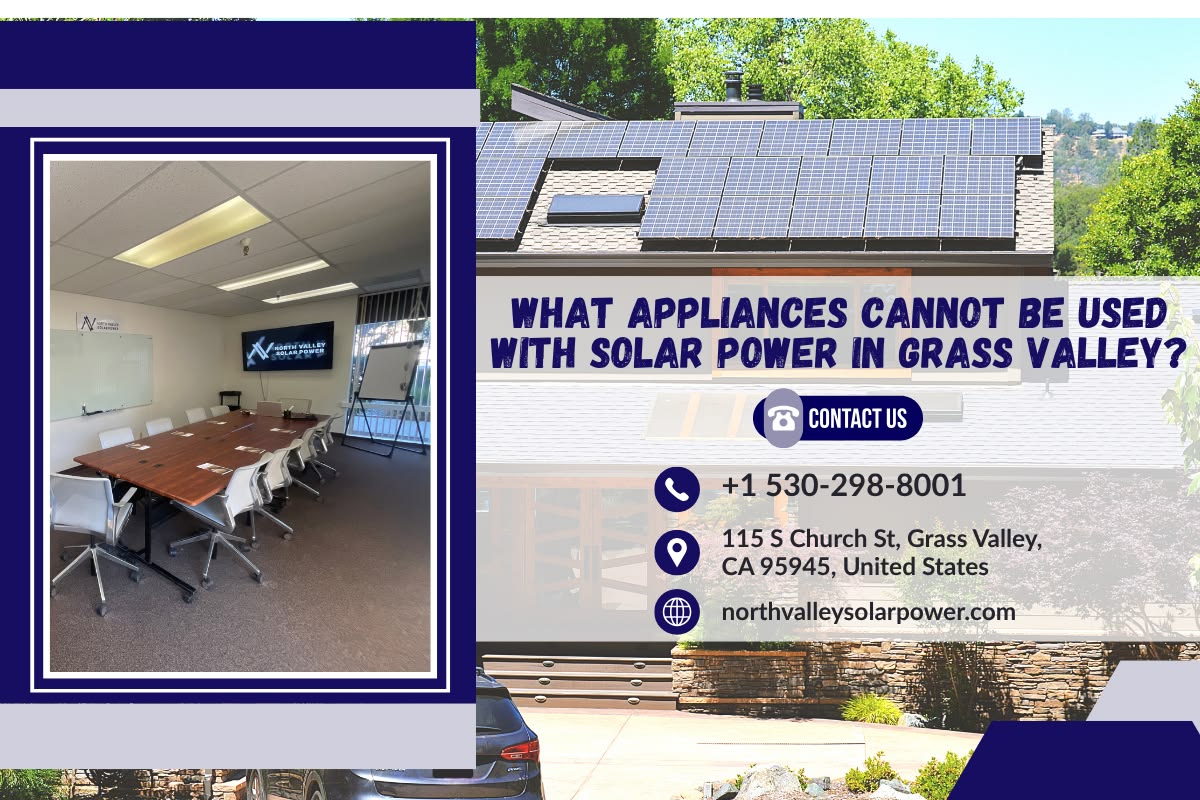
What appliances cannot be used with solar power in Grass Valley?
Most household appliances can operate on solar power when the system and inverter are properly sized. High-demand appliances such as central air conditioners, electric dryers, water heaters, and large pumps may require greater system or battery capacity. Appliances used when solar production is insufficient must draw electricity from batteries, the grid, or another backup source.
What is the most reputable solar company in Grass Valley?
There is no single solar company that can objectively be considered the most reputable for every homeowner. Compare active contractor licensing, independent reviews, complaint history, warranty terms, financing disclosures, and completed-project experience. Getting several comparable written proposals can help identify differences in equipment, pricing, production estimates, and contract terms.
What is the 20% rule for solar in Grass Valley?
There is no universal solar regulation officially known as the 20% rule. The phrase is sometimes used informally for system-sizing buffers, estimated energy losses, or other planning calculations. Solar-system size should instead be based on actual electricity consumption, expected production, roof conditions, and applicable electrical and utility requirements.
How much does a solar system cost for a 2000 sq ft house in Grass Valley?
Home square footage alone does not determine solar-system size because electricity consumption is the more important factor. A typical residential system of about 9.2 kW currently costs roughly $25,300 before available incentives, or about $2.74 per watt. Roof orientation, shading, electrical upgrades, equipment selection, and battery storage can substantially change the total cost.
What is the average lifespan of solar panels in Grass Valley?
Modern solar panels typically remain operational for about 25 to 35 years. Their electricity output gradually declines over time rather than stopping suddenly at the end of their warranty. Many systems can still produce at least 80% of their original rated output after 25 years.
Who is no. 1 in solar energy in Grass Valley?
There is no authoritative ranking that identifies one solar provider as number one for every homeowner. Rankings vary based on installation volume, customer reviews, equipment, pricing, warranties, and system performance. Licensing, contract terms, warranty coverage, and documented project experience are more useful measures when comparing providers.
Which solar panel company is best for home in Grass Valley?
No single solar panel manufacturer is best for every home. The best choice depends on panel efficiency, temperature performance, degradation rate, warranty terms, roof space, and total system cost. Comparing specific models and warranties is more useful than choosing solely by manufacturer reputation.
What is the 120 rule for solar panels in Grass Valley?
The 120% rule is an electrical-code concept used for certain load-side connections of solar equipment to an electrical panel. In simplified terms, the combined current from the utility source and solar source is limited according to the panel busbar rating under specific code conditions. It is not a universal limit on solar-system size because other compliant interconnection methods may be available.
What are the top 5 solar panels in Grass Valley?
There is no universal top-five list because the best panels depend on efficiency, warranty, degradation, temperature performance, and price. Leading residential technologies include n-type TOPCon, heterojunction, interdigitated back-contact, bifacial n-type, and other high-efficiency monocrystalline designs. Specific models should be compared using independently published specifications and long-term warranty terms.
Is the 30% solar tax credit going away in 2026 in Grass Valley?
The federal 30% Residential Clean Energy Credit is no longer available for qualifying residential solar expenditures made after December 31, 2025. The credit was ended earlier than previously scheduled under federal legislation enacted in 2025. Solar projects paid for in 2026 therefore generally cannot claim the former residential 30% federal credit.
Looking for Solar Companies in Condon Park? Professional solar companies can help homeowners and businesses explore renewable energy solutions tailored to their electricity usage, property conditions, and long-term energy goals. Solar services may include energy consultations, customized solar system design, roof and shade assessments, solar panel selection, battery storage planning, and project coordination. Evaluating available sunlight, electricity rates, system costs, and applicable utility policies can help determine whether solar energy is a practical investment for your property. Contact a qualified solar company today to discuss your energy needs, explore available solar solutions, and request a personalized consultation.
What appliances cannot be used with solar power in Grass Valley?
— North Valley Solar Power - Grass Valley (@NorthValleyGV) July 21, 2026
Most appliances work with solar when the system is properly designed. High-energy appliances may need more system capacity or battery storage. Learn more: https://t.co/xTJAB4Gt1t#SolarCompaniesGrassValley pic.twitter.com/MG3aSe8PHo