HPT
High Performance
Tutoring
Free Weekly SAT Workshops · Week 10

Geometry
& Trig.

Angles, special triangles, scaling, trig, and circles.
Live on Zoom 100% Free No registration
These are the moves the SAT rewards that most classes rush right past.

How much bigger?

SAT-style · warm-up vote: 30 sec in chat, then GO
The radius of circle B is 3 times the radius of circle A. The area of circle B is how many times the area of circle A?
A3 times
B6 times
C9 times
D27 times
r3rCircle ACircle BNote: Figures not drawn to scale.
!
Hold on to your vote. We will come back to this in Section 3.
01
Section 1 · about 10 minutes

Angles.

Three facts and one big unlock: parallel lines.

Three facts to keep in your pocket.

123°57°
Straight Line = 180°
The angles along a line add to 180.
40°60°80°
Triangle = 180°
The three inside angles add to 180.
70°70°110°110°
Vertical Angles are Equal
Where two lines cross, the angles across from each other match.
On the SAT, the trick is knowing when to use each of these properties.

Two facts, one problem.

SAT-style · your turn: 45 sec, then GO
In the triangle shown, side \(BC\) is extended to point \(D\). What is the value of \(x\)?
A47180 − 98 − 35
B63✓
C133added the angles
D145180 − 35
ABCD35°x°98°82°x = 63
Step 1 · Straight Line = 180°
\(BCD\) is a straight line, so the inside angle at \(C\) is \(180-98=82^\circ\).
Step 2 · Triangle = 180°
The three angles of \(ABC\) add to 180: \(x=180-35-82=63\).

Parallel lines: only two angles.

YOU DO NOT NEED:Alternate InteriorAlternate ExteriorConsecutive InteriorCorresponding
61°61°119°119°61°61°119°119°
8 angles: 4 small and 4 big.
•  All the smalls are equal.
•  All the bigs are equal.
Small + Big = 180°
One line crossing two parallel lines: know one of the 8 angles and you know all 8. (If it crosses at 90°, all eight are 90°.) On the SAT, this unlocks most of the angles in a figure.

Small or big?

SAT-style · your turn: 45 sec, then GO
In the figure, lines \(p\) and \(q\) are parallel. What is the value of \(x\)?
A30✓
B50set them equal
C70that is the small angle
D110that is the big angle
pq(3x − 20)°(x + 80)°Note: Figure not drawn to scale.
Step 1 · Equal, or add to 180°?
One angle is small and one is big, so they are not equal. They add to 180°:
\((3x-20)+(x+80)=180\)
Step 2 · Solve
\(4x+60=180\), so \(4x=120\) and \(x=30\). (Check: \(70^\circ+110^\circ=180^\circ\).)
02
Section 2 · about 12 minutes

Similar Triangles.

One reminder, then two SAT problems that tie it all together.

Similar triangles.

54610812originalcopy at 200%, flipped⟶
Same Angles
All corresponding angles are equal.
Proportional Sides
All sides scale by the same factor.
\(\dfrac{10}{5}=\dfrac{8}{4}=\dfrac{12}{6}=2\)

An Example Problem

SAT-style · your turn: 45 sec, then GO
In the figure, \(AB \parallel DE\), and segments \(AE\) and \(BD\) meet at \(C\). What is the length of \(DE\)?
A48flipped
B27✓
C24wrong match
D30guess
ABCDE362418?= 27
Step 1 · Parallel lines
\(AE\) crosses the parallel lines. \(\angle A\) and \(\angle E\) are both small, so \(\angle A=\angle E\).
Step 2 · Parallel lines again
\(BD\) crosses them too. \(\angle B\) and \(\angle D\) are both small, so \(\angle B=\angle D\).
Step 3 · Vertical angles
The two angles at \(C\) are vertical angles, so they are equal.
Step 4 · Similar
All angles match, so \(\triangle ABC\sim\triangle EDC\).
Step 5 · Proportion
\(\dfrac{DE}{36}=\dfrac{18}{24}\ \Rightarrow\ DE=27\)

Another Example Problem

SAT-style · your turn: 45 sec, then GO
In right triangle \(ABC\), angle \(C\) is a right angle. Point \(D\) lies on \(AB\) so that \(CD\perp AB\). If \(AD=4\) and \(DB=9\), what is the length of \(CD\)?
A6✓
B6.5averaged
C13added
D36no √
ABCD49?= 6
Step 1 · Right angles
\(CD\perp AB\), so both angles at \(D\) are 90°.
Step 2 · Triangle = 180°
In \(\triangle ABC\): \(\angle A+\angle B=90^\circ\). In \(\triangle ADC\): \(\angle A+\angle ACD=90^\circ\). So \(\angle ACD=\angle B\).
Step 3 · Same idea
In \(\triangle CDB\): \(\angle B+\angle BCD=90^\circ\), so \(\angle BCD=\angle A\).
Step 4 · Similar
All angles match, so \(\triangle ADC\sim\triangle CDB\).
Step 5 · Proportion
\(\dfrac{AD}{CD}=\dfrac{CD}{DB}\ \Rightarrow\ \dfrac{4}{CD}=\dfrac{CD}{9}\)
\(CD^2=36\ \Rightarrow\ CD=6\)
03
Section 3 · about 8 minutes

Scaling laws.

Multiply every length by k. What happens to area? To volume?

Triple every length. What happens?

Length (1D)13×3Area (2D)×9 = ×3²Volume (3D)×27 = ×3³
Works for every shape, as long as every length scales by the same \(k\):
lengths \(\times k\), areas \(\times k^2\), volumes \(\times k^3\).

A model car and a real car.

An exact scale model, inside and out: model lengths are \(\tfrac{1}{10}\) of the real car’s.
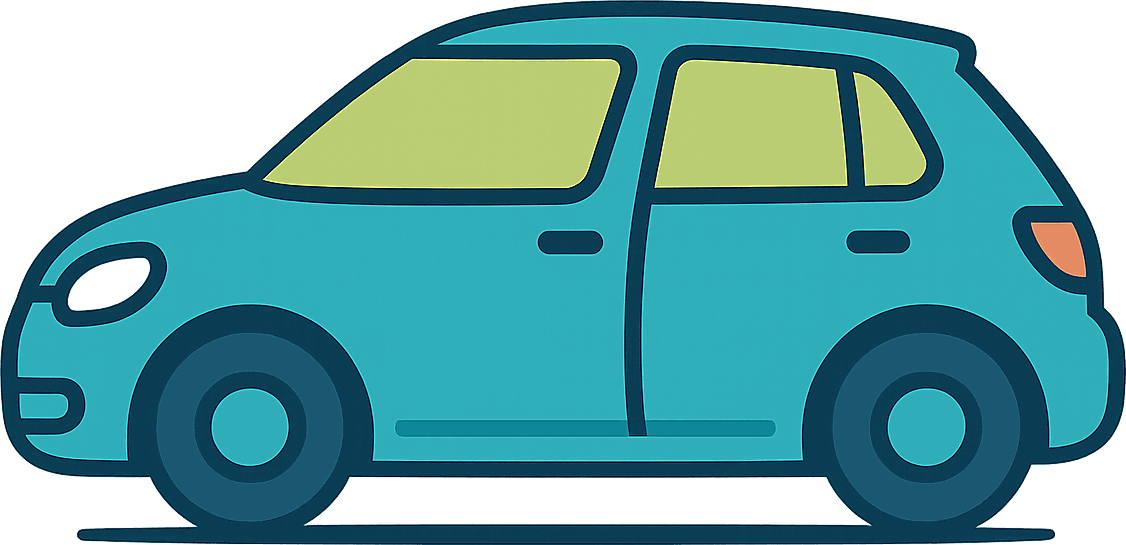
01 ft
model
012345678910 ft
real car
1D Measurements (×10)
  • Height
  • Width
  • Steering-wheel radius
  • Width of the trunk
2D Measurements (×100)
  • Paint for the outside
  • Windex for the windows
  • Tire shine for the tires
3D Measurements (×1000)
  • Air in the tires
  • Gas in the tank
  • Trunk and glove-box space
Lengths: \(\times10\). Areas you cover: \(\times10^2=100\). Volumes you fill: \(\times10^3=1000\).

Back to the circles.

SAT-style · your turn: 20 sec, then GO
The radius of circle B is 3 times the radius of circle A. The area of circle B is how many times the area of circle A?
A3 timesthat is the radius (1D)
B6 timesdoubled the 3
C9 times✓
D27 timesthat is volume (3D)
9 copies of A's squarerA3rB
Since the radius (1D) scales by a factor of 3, the area (2D) must scale by a factor of \(3^2=9\).
Check: say circle A has radius 1, so its area is \(\pi(1)^2=\pi\).
Then circle B has radius 3, so its area is \(\pi(3)^2=9\pi\): 9 times as big.
04
Section 4 · about 15 minutes

Right Triangles.

A quick SOH-CAH-TOA reminder, then the one identity classes skip.

SOH-CAH-TOA and Pythagoras.

ACBaOPPbADJcHYP
SOH  \(\sin A=\dfrac{\text{opp}}{\text{hyp}}\)
CAH  \(\cos A=\dfrac{\text{adj}}{\text{hyp}}\)
TOA  \(\tan A=\dfrac{\text{opp}}{\text{adj}}\)
Pythagorean Theorem
\(a^2+b^2=c^2\)

Pythagoras, then SOH-CAH-TOA.

SAT-style · your turn: 45 sec, then GO
In right triangle \(ABC\), angle \(C\) is a right angle, \(BC=8\), and \(AB=17\). What is the value of \(\cos A\)?
A\(\dfrac{8}{17}\)sin
B\(\dfrac{15}{17}\)✓
C\(\dfrac{8}{15}\)tan
D\(\dfrac{17}{15}\)flipped
ACB817OPPHYPADJ15
Step 1 · Name the sides from \(A\)
\(BC\) is opposite \(A\), \(AB\) is the hypotenuse, \(AC\) is adjacent.
\(\cos A=\dfrac{\text{ADJ}}{\text{HYP}}\), but \(AC\) is not given.
Step 2 · Pythagorean Theorem
\(8^2+AC^2=17^2\Rightarrow AC^2=225\Rightarrow AC=15\)
Step 3 · SOH-CAH-TOA
\(\cos A=\dfrac{AC}{AB}=\dfrac{15}{17}\)

A rectangle inside a circle.

SAT-style · your turn: 60 sec, then GO
Rectangle \(ABCD\) is inscribed in a circle. \(BC=6\), and diagonal \(AC\) makes a \(30^\circ\) angle with side \(AB\). What is the area of the circle?
A\(144\pi\)12 as radius
B\(36\pi\)✓
C\(12\pi\)circumference
D\(9\pi\)radius 3
30°6ABCD12r = 6
Step 1 · Find the right triangle
Corner \(B\) is 90°, so \(\triangle ABC\) is a right triangle. Diagonal \(AC\) is its hypotenuse, and \(BC=6\) is opposite the 30°. So find \(AC\).
Step 2 · SOH
\(\sin30^\circ=\dfrac{BC}{AC}\Rightarrow\dfrac12=\dfrac{6}{AC}\Rightarrow AC=12\)
Step 3 · Diagonal = diameter
\(AC=12\) is the diameter of the circle,
so the radius is 6.
Step 4 · Area
\(A=\pi r^2=\pi(6)^2=36\pi\)

Sine and cosine trade places.

ACBacb
The two small angles add to 90°: \(A+B=90^\circ\).
\(\sin A=\dfrac{\textcolor{#e06666}{a}}{\textcolor{#a8c63e}{c}}\)  and  \(\cos B=\dfrac{\textcolor{#e06666}{a}}{\textcolor{#a8c63e}{c}}\)
\(\sin B=\dfrac{\textcolor{#7fb2e5}{b}}{\textcolor{#a8c63e}{c}}\)  and  \(\cos A=\dfrac{\textcolor{#7fb2e5}{b}}{\textcolor{#a8c63e}{c}}\)
Complementary angles swap sin and cos. For acute angles, \(\sin A=\cos B\) means \(A+B=90^\circ\).
Example: \(70^\circ+20^\circ=90^\circ\), so \(\sin70^\circ=\cos20^\circ\) and \(\cos70^\circ=\sin20^\circ\).

No triangle needed.

SAT-style · your turn: 30 sec, then GO
In right triangle \(RST\), angle \(T\) is a right angle. If \(\sin R=\dfrac{\sqrt{15}}{4}\), what is \(\cos S\)?
A\(\dfrac{1}{4}\)that is cos R
B\(\dfrac{1}{4}-\dfrac{\sqrt{15}}{4}\)subtracted
C\(\dfrac{\sqrt{15}}{4}\)✓
D\(\dfrac{4}{\sqrt{15}}\)flipped the fraction
Step 1 · Triangle = 180°
\(T=90^\circ\), so the other two angles share the remaining 90°: \(R+S=90^\circ\).
Step 2 · Sine and cosine trade places
\(R\) and \(S\) add to 90°, so \(\cos S=\sin R=\dfrac{\sqrt{15}}{4}\).

A sin equal to a cos.

SAT-style · your turn: 45 sec, then GO
If \(\cos(x+17)=\sin(2x+10)\) and both angles are acute, what is the value of \(x\)?
All angles are measured in degrees.
A7set the angles equal
B21✓
C30dropped the 17 and 10
D38that is x + 17
Step 1 · Sine and cosine trade places
A cos equals a sin, so the two angles add to 90°: \((x+17)+(2x+10)=90\)
Step 2 · Solve
\(3x+27=90\Rightarrow 3x=63\Rightarrow x=21\)
05
Section 5 · about 7 minutes

Circles.

One equation. Read the center and the radius straight off it.

Equation ↔ graph.

xy(3, −2)r = 4(3, 2)
\((x-\textcolor{#e7c24a}{h})^2+(y-\textcolor{#e7c24a}{k})^2=\textcolor{#a8c63e}{r}^2\)
Center \((\textcolor{#e7c24a}{h},\textcolor{#e7c24a}{k})\)   Radius \(\textcolor{#a8c63e}{r}\)
\((x-\textcolor{#e7c24a}{3})^2+(y+\textcolor{#e7c24a}{2})^2=\textcolor{#a8c63e}{16}\)
Center \((\textcolor{#e7c24a}{3},\textcolor{#e7c24a}{-2})\): flip the signs.  Radius \(\sqrt{16}=\textcolor{#a8c63e}{4}\)
Is the point \((3,2)\) on the circle? Plug it in:
\((\textcolor{#e06666}{3}-\textcolor{#e7c24a}{3})^2+(\textcolor{#e06666}{2}+\textcolor{#e7c24a}{2})^2=\textcolor{#a8c63e}{16}\)
\(0^2+4^2=16\)
\(16=16\ \checkmark\)

Build the equation.

SAT-style · your turn: 45 sec, then GO
A circle in the \(xy\)-plane has its center at \((4,-7)\) and passes through the point \((4,8)\). Which equation represents the circle?
A\((x-4)^2+(y+7)^2=225\)✓
B\((x-4)^2+(y+7)^2=15\)r, not r²
C\((x+4)^2+(y-7)^2=225\)wrong center
D\((x+4)^2+(y-7)^2=15\)wrong center
(4, −7)(4, 8)15
Step 1 · Center
Center \((4,-7)\) means \((x-4)\) and \((y+7)\): flip the signs. C and D have the wrong center.
Step 2 · Radius
Same \(x\), so measure up: from \(y=-7\) to \(y=8\) is \(8-(-7)=15\). So \(r=15\).
Step 3 · Right side is \(r^2\)
\(r^2=15^2=225\), so the answer is A. (B used \(r\), not \(r^2\).)
Tonight in one slide

Five takeaways.

Angles
Straight line \(=180^\circ\)  ·  Triangle \(=180^\circ\)  ·  Vertical angles are equal
Parallel lines: Small + Big \(=180^\circ\)
Similar Triangles
Same angles  ·  Proportional sides: every side \(\times k\)
Scaling Laws
Length \(\times k\)  ·  Area \(\times k^2\)  ·  Volume \(\times k^3\)
Right Triangles
\(a^2+b^2=c^2\)  ·  SOH-CAH-TOA  ·  \(\sin A=\cos B\) when \(A+B=90^\circ\)
Circles
\((x-h)^2+(y-k)^2=r^2\): center \((h,k)\), radius \(r\)

Practice this week.

Q
Practice questions from tonight, with worked answers.
Try → check → explain one mistake out loud.

Bluebook
Download the Bluebook app to take free, full-length practice SATs from the College Board.
FREE · EVERY WEEK
Scan for practice + answers
highperformancetutoring.com
GREAT WORK TODAY

One question
before you go?

NEXT WEEK
Desmos & Calculator Mastery
Thursday, Oct 29  ·  5:00 PM PT
REJOIN ANY SESSION zoom.us/j/89849937335 Bring a friend next week.