The discriminant, exponential growth, and reading f(x).
Live on Zoom100% FreeNo registration
These are the moves the SAT rewards that most classes rush right past.
01
Section 1
Quadratics.
A quadratic has three outfits.
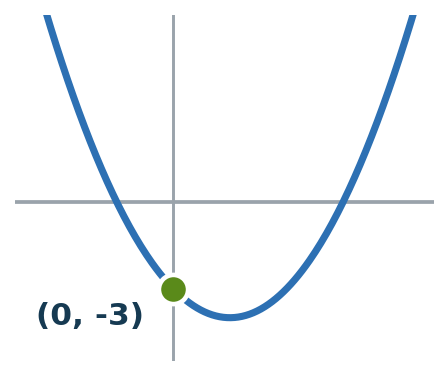
Standard
\(y=ax^2+bx+c\)
c is the y-intercept.
Example\(y=x^2-2x\)\(-3\)
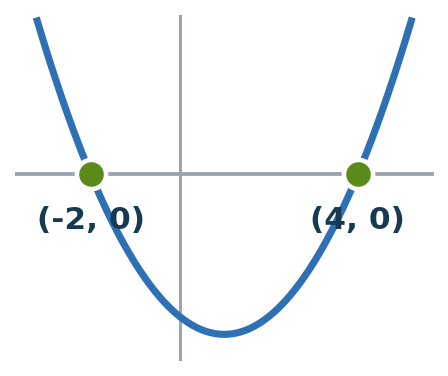
Factored
\(y=a(x-p)(x-q)\)
p and q are the x-intercepts.
Example\(y=(x\)\(-4\)\()(x\)\(+2\)\()\)
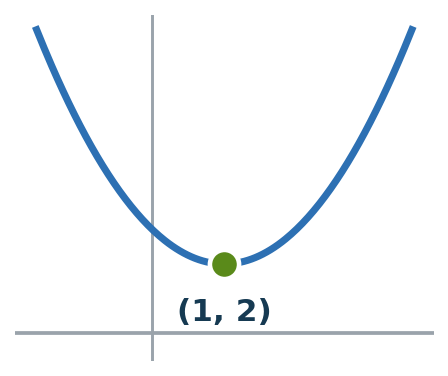
Vertex
\(y=a(x-h)^2+k\)
(h, k) is the vertex.
Example\(y=(x\)\(-1\)\()^2\)\(+2\)
Tip
Each form hands you a different fact for free. Match the question to the form, and convert only when you must.
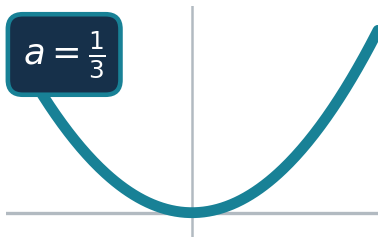
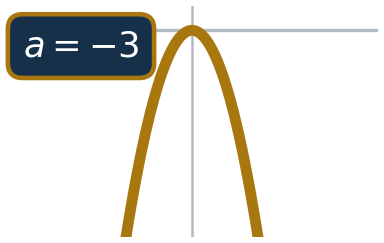
The a controls the shape.
Standard
\(y=\)\(a\)\(x^2+bx+c\)
Factored
\(y=\)\(a\)\((x-p)(x-q)\)
Vertex
\(y=\)\(a\)\((x-h)^2+k\)
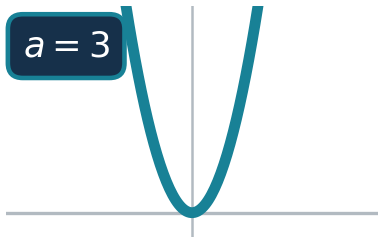
NARROW
larger a
WIDE
smaller a
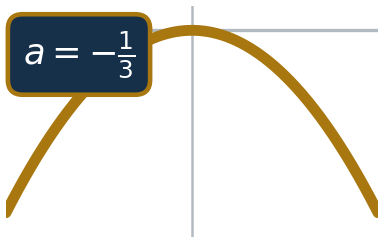
OPENS UP
a is positive
OPENS DOWN
a is negative
Which point is an x-intercept?
Problem · your turn: 30 sec, then GO
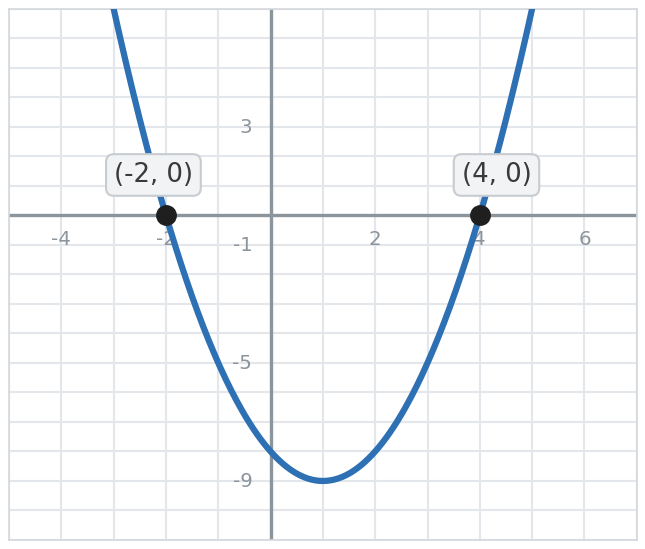
Which of the following is an x-intercept of the graph of \(y=(x-4)(x+2)\)?
\((x-4)(x+2)=0\)so\(x=4\)or\(x=-2\)
A\((4,\,0)\)✓
B\((2,\,0)\)sign slip
C\((-4,\,0)\)sign slip
D\((0,\,-8)\)y-intercept
Set each factor to \(0\): \(x-4=0\) gives \(x=4\), \(x+2=0\) gives \(x=-2\). The x-intercepts are \((4,0)\) and \((-2,0)\); only \((4,0)\) is listed. Note \((0,-8)\) is the y-intercept.
Or just let Desmos show you.
1
\(y=(x-4)(x+2)\)
Type the equation and Desmos marks the x-intercepts for you. Great for checking your work when the problem gives you numbers to type.
No numbers? Fundamentals win.
Problem · your turn: 30 sec, then GO
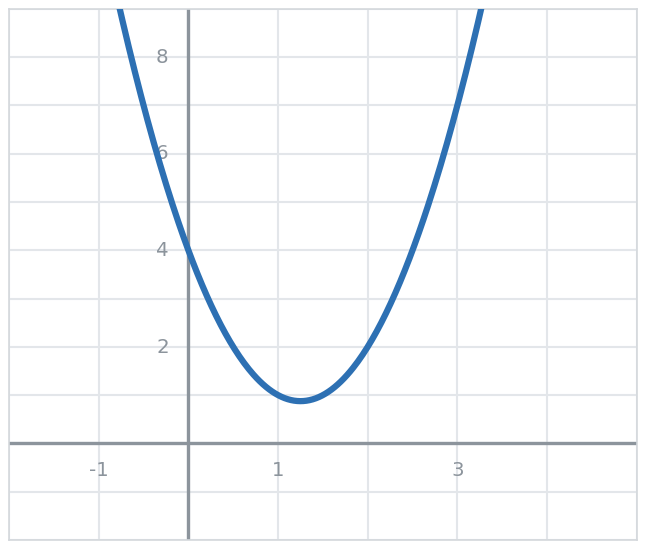
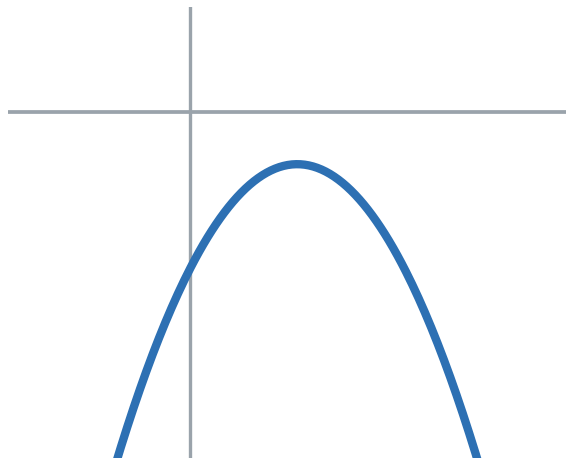
The graph of \(y=ax^2+bx+c\) is shown. Which of the following must be true?
A\(ac>0\)✓
B\(ac<0\)
C\(ac=1\)
D\(ac=0\)needs c = 0
The graph opens down, so \(a<0\). The y-intercept is \(c\), and it sits below the x-axis, so \(c<0\). A negative times a negative is positive, so \(ac>0\). We never need the actual values.
The Discriminant.
Quadratic equation
\(ax^2+bx+c=0\)
→
Discriminant
\(D\)\(=b^2-4ac\)
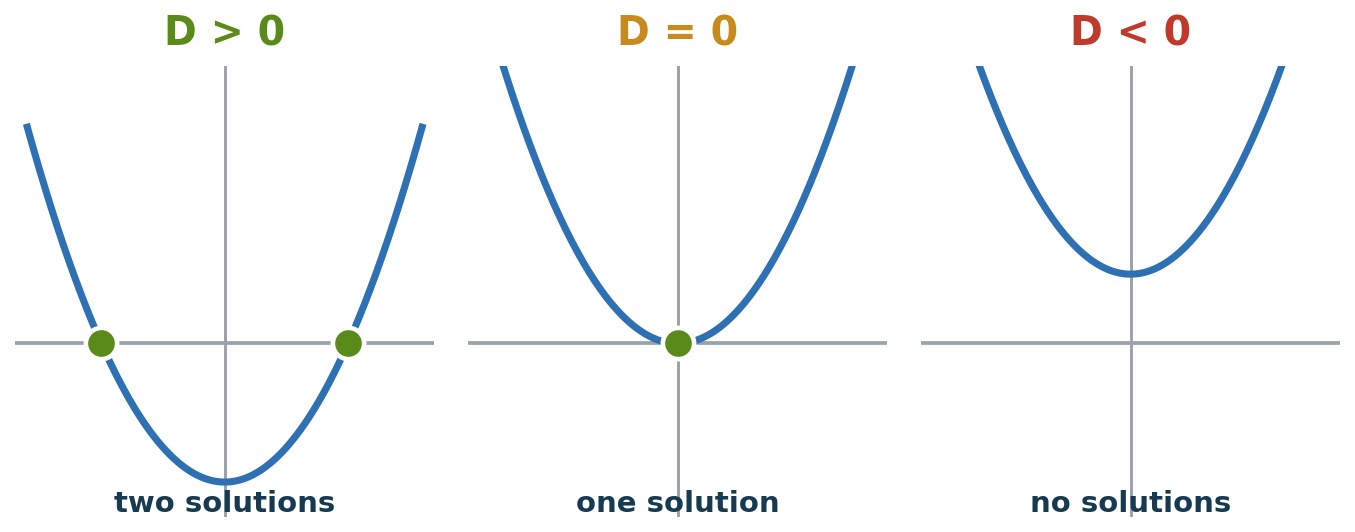
How many solutions?
Problem · your turn: 30 sec, then GO
How many real solutions does \(2x^2-5x+4=0\) have?
It does not factor nicely, so check the discriminant. Here \(a=2,\ b=-5,\ c=4\).
\(D\)\(=b^2-4ac=(-5)^2-4(2)(4)=25-32=\)\(-7\)
A0✓
B1that needs D = 0
C2that needs D > 0
DCannot tell
\(D\)\(=b^2-4ac=25-32=-7\). Since \(D<0\), there are no real solutions. The numbers do not factor, so the discriminant is the quick way to know.
Or graph it on Desmos.
1
\(y=2x^2-5x+4\)
The parabola never touches the x-axis, so there are no real solutions. That is exactly what \(D<0\) told us.
Which k gives no solutions?
Problem · your turn: 30 sec, then GO
\(x^2+kx+9=2x\), where \(k\) is a constant. For which value of \(k\) does the equation have no real solutions?
Move everything to one side: \(x^2+(k-2)x+9=0\). No real solutions means \(D<0\): \((k-2)^2-36<0\), so \(-4<k<8\). Only \(k=7\) fits. On Desmos you would test every k with a slider; the discriminant settles it in one step.
Or slide k on Desmos.
1
\(y=x^2+(k-2)x+9\)
2
\(k=7\)
-10
10
Move everything to one side, put k on a slider, and hunt for a value where the parabola stops crossing the x-axis. It works, but you test them one at a time. The discriminant gives \(-4<k<8\) directly.
No slider will save you.
Problem · your turn: 30 sec, then GO
\(-x^2+kx-16=0\), where \(k\) is an integer constant. For how many values of \(k\) does the equation have no real solution?
\(D\)\(=b^2-4ac=k^2-4(-1)(-16)=k^2-64\)
\(k^2-64<0\)→\(-8<k<8\)→\(k=-7,-6,\dots,7\)
A15✓
B17counts k = ±8 (D = 0)
C8forgot negative k
DInfinitely many
The discriminant is \(D\)\(=k^2-4(-1)(-16)=k^2-64\). No real solutions means \(D<0\), so \(k^2<64\), i.e. \(-8<k<8\). The integers \(-7\) through \(7\) make 15 values. A slider cannot hand you a count; the discriminant gives the whole range at once.
02
Section 2
Exponential growth.
Linear adds. Exponential multiplies.
Linear
\(y=\)\(m\)\(x+\)\(b\)
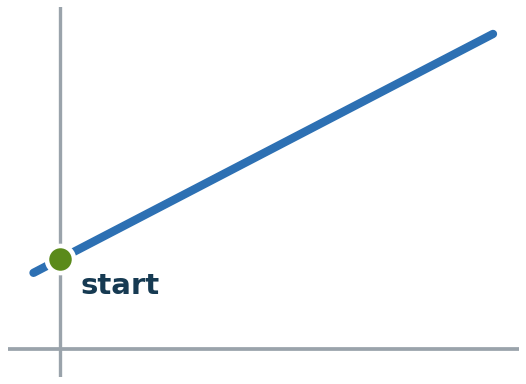
m = how much you add each step
b = the starting value
A gym: $b to join, then $m every month.
Exponential
\(y=\)\(a\)\(\cdot\)\(b\)\(^{\,x}\)
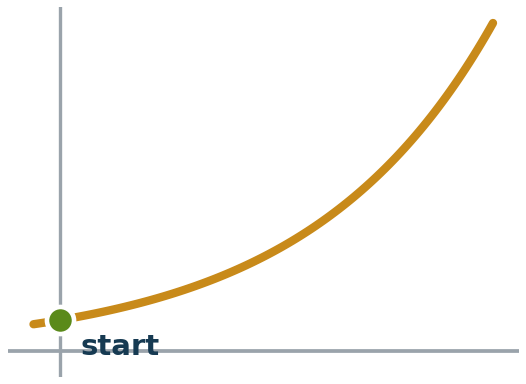
a = the starting value
b = the multiplier (×b each step)
$a in an account that grows ×b each year.
Pick the model.
Problem · your turn: 30 sec, then GO
A $1,000 laptop loses 15% of its value each year. Which models its value after t years?
Losing 15% keeps 85%, so multiply by \(0.85\) each year.
\(V=1000\cdot(0.85)^{\,t}\)
A\(1000(0.85)^t\)✓
B\(1000(1.15)^t\)that is 15% growth
C\(1000-150t\)that is linear
D\(1000(0.15)^t\)keeps only 15%
Decay keeps \(100\%-15\%=85\%\) each year, so the factor is \(0.85\) and the model is \(1000(0.85)^t\). Subtracting 150 each year (C) would be linear.
Double every day.
Problem · your turn: 30 sec, then GO
A pond has 300 algae and the amount doubles every day. How many after 3 days?
\(300\cdot 2^{\,3}=300\cdot 8=\)\(2400\)
A\(1{,}800\)300 × (2×3)
B\(2{,}400\)✓
C\(900\)300 × 3, added not doubled
D\(600\)
Doubling means \(\times 2\) each day, so after 3 days \(300\cdot 2^3=300\cdot 8=\)\(2400\). The exponent is the number of steps.
The exponent rules.
Multiply → add
\(x^a \cdot x^b = x^{a+b}\)
\(2^2 \cdot 2^3 = 2^5\)
Divide → subtract
\(\dfrac{x^a}{x^b}=x^{a-b}\)
\(\dfrac{2^5}{2^2}=2^3\)
Power of a power → multiply
\((x^a)^b=x^{ab}\)
\((2^2)^3=2^6\)
Zero power
\(x^0=1\)
\(9^0=1\)
Negative → flip
\(x^{-a}=\dfrac{1}{x^a}\)
\(2^{-3}=\dfrac{1}{8}\)
Fraction → root
\(x^{1/n}=\sqrt[n]{x}\)
\(9^{1/2}=3\)
Rules, or just plug in.
Problem · your turn: 30 sec, then GO
Which of the following is equivalent to \(\dfrac{(x^3)^2 \cdot x^{-4}}{x}\)?
Not sure? Plug in a number. Let \(x=2\): \(\dfrac{(2^3)^2 \cdot 2^{-4}}{2}=\dfrac{64 \cdot \frac{1}{16}}{2}=\dfrac{4}{2}=2\), which matches \(x=2\). Both routes give \(x\).
03
Section 3
Functions & graphs.
f(x) is just a machine.
f(x) is a machine.\(f(3)\) means put 3 in.
\(3\)
→
RULE
\(f(x)=x^2+1\)
→
\(f(3)=10\)
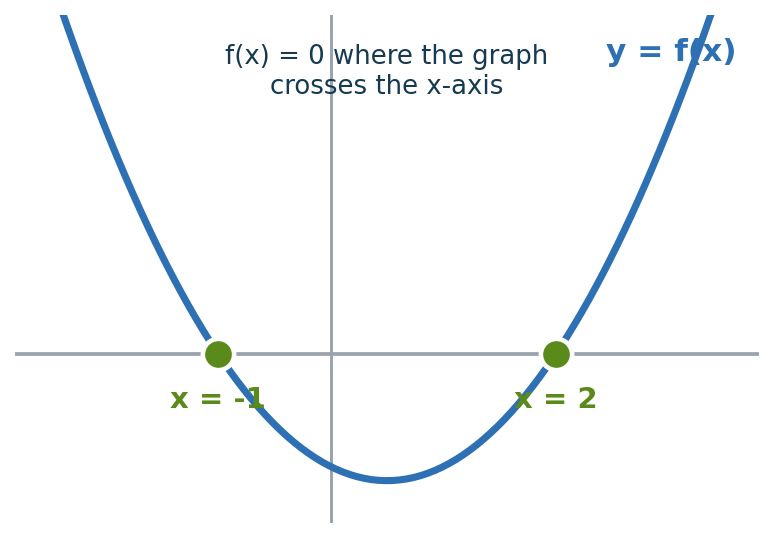
\(f(x)=0\) = the x-intercepts. \(f(x)=g(x)\) = where graphs meet.
Put the number in.
Problem · your turn: 30 sec, then GO
If \(f(x)=2x^2-3\), what is \(f(4)\)?
\(f(4)=2(4)^2-3=2(16)-3=32-3=\)\(29\)
A29✓
B13forgot to square first
C61squared 2×4
D5did 2×4−3
Put 4 in for x: \(2(4)^2-3\). Square first: \(4^2=16\), then \(2\cdot 16-3=\)\(29\). Order of operations: exponent before the multiply.
Where is f(x) = 0?
Problem · your turn: 30 sec, then GO
The graph of \(y=f(x)\) is shown. What are the solutions to \(f(x)=0\)?
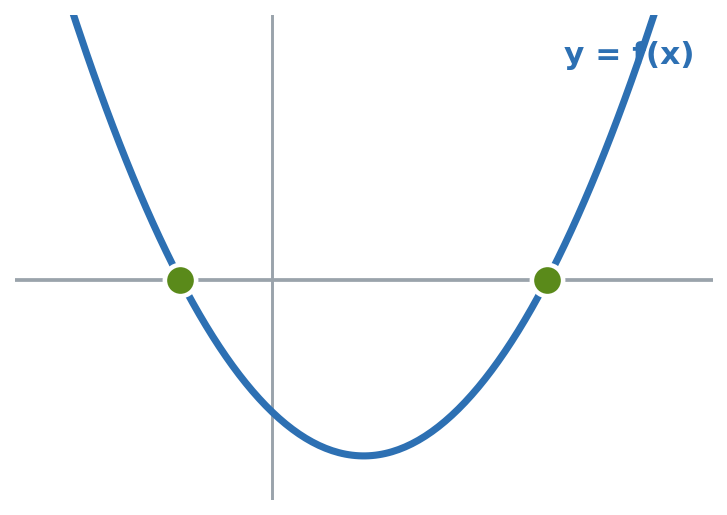
A\(x=-1\) and \(x=3\)✓
B\(x=0\)that is the y-value
C\(x=-3\) and \(x=1\)sign flip
D\(y=-3\)the lowest point
\(f(x)=0\) asks where the graph crosses the x-axis. It crosses at \(x=-1\) and \(x=3\), so those are the solutions.
A shifted function.
Problem · your turn: 30 sec, then GO
The table gives values of the linear function \(f\). If \(g(x)=f(x-2)+3\), for what value of \(x\) is \(g(x)=5\)?
\(x\)
\(f(x)\)
1
2
2
3
3
4
\(g(x)=5\)→\(f(x-2)+3=5\)→\(f(x-2)=2\)
Table: \(f=2\) when the input is \(1\), so \(x-2=1\)\(\Rightarrow x=3\)
A\(x=3\)✓
B\(x=1\)forgot the shift
C\(x=-1\)shifted the wrong way
D\(x=5\)
\(g(x)=5\) means \(f(x-2)+3=5\), so \(f(x-2)=2\). From the table \(f=2\) when the input is \(1\), so \(x-2=1\), giving \(x=3\). The input to f is \(x-2\), so solve \(x-2=1\), not \(x=1\).
What will you do first?
Three moves.
Before each caption appears, call out the first move in the chat.
\(b^2-4ac\)
Quadratics
Read the form; count with the discriminant.
\(a\cdot b^{\,t}\)
Exponentials
Multiply, do not add.
\(f(x)\)
Functions
A machine; zeros are x-intercepts.
Try three more this week.
3
Three questions, one from each theme, with worked answers.
Try → check → explain one mistake out loud.
BB
The official Bluebook app, for full-length practice.
FREE · EVERY WEEK

Scan for practice + answers
highperformancetutoring.com
GREAT WORK TODAY
One question before you go?
NEXT WEEK
Math: Geometry & Trigonometry
Thursday, Oct 22 · 5:00 PM PT

REJOIN ANY SESSIONzoom.us/j/89849937335Bring a friend next week.