HPT
High Performance
Tutoring
Free Weekly SAT Workshops · Week 8

Problem-Solving
& Data.

Three moves: scale it, read it, describe it.
Live on Zoom 100% Free No registration
The data section looks intimidating. It is really careful reading plus a little arithmetic.
A $100 shirt

Up 20%, then down 20%.
Is it still the same?

shirt$100→+20%→?→−20%→?

Yes
No
Maybe
01
Section 1

Percentages.

Percentage factors.

Percent OF
a part of a whole
\(\times 0.20\)
\(20\% \text{ of } 50 = 0.20 \times 50 = \)\(10\)
\(35\% \text{ of } 80 = 0.35 \times 80 = \)\(28\)
Percent MORE than
keep 100%, add it
\(\times 1.20\)
\(20\% \text{ more: } 1.20 \times 50 = \)\(60\)
\(8\% \text{ more: } 1.08 \times 200 = \)\(216\)
Percent LESS than
keep what remains
\(\times 0.80\)
\(20\% \text{ less: } 0.80 \times 50 = \)\(40\)
\(25\% \text{ less: } 0.75 \times 80 = \)\(60\)
Every percent is really a multiplier. Turn the percent into a decimal, then build the factor.

Turn the words into an equation.

what → \(x\)is → \(=\)of → \(\times\)% → decimal
“What is 12% of 50?”
\(x\)\( = 0.12 \times 50\)
“What is 20% more than 80?”
\(x\)\( = 1.20 \times 80\)
“17 is what percent of 33?”
\(17 = \)\(p\)\( \times 33\)
“8 is 40% of what number?”
\(8 = 0.40 \times \)\(x\)

18 is what percent of 72?

Problem · your turn: 30 sec, then GO
18 is what percent of 72?
\(18 = \)\(p\)\( \times 72\)
A18%
B400%72/18
C25%✓
D75%

60 is 40% of what number?

Problem · your turn: 30 sec, then GO
60 is 40% of what number?
\(60 = 0.40 \times \)\(x\)
A240.40 × 60
B150✓
C100
D240

Percent Compounds.

An $80 shirt is 30% off, but tax adds 10%. What is the final price?
$80
×
0.7
30% off
×
1.1
10% tax
=
$61.60
Percents compound: just multiply the factors in order.
Back to the hook: a $100 shirt, up 20% then down 20%.
$100
×
1.2
up 20%
×
0.8
down 20%
=
$96
$96, not $100. The second 20% comes off the larger $120, so it takes more than was added.

Two 10% drops.

Problem · your turn: 30 sec, then GO
A car's value drops 10% the first year and 10% the second year. After two years, its value is what percent of the original?
Its value was never given, so pick an easy start: $100.
\(\$100 \times 0.90 \times 0.90 = \)\(\$81\)
A80%added the drops
B81%✓
C19%
D90%
Picking $100 is allowed because the car’s value was never given. $81 out of $100 is 81%, the answer is a percent either way.

a is what percent of c?

Problem · your turn: 30 sec, then GO
a is 30% of b, and c is 60% of b (with b > 0). Then a is what percent of c?
\(a = 0.30b\) and \(c = 0.60b\)
A18%0.30 × 0.60
B50%✓
C90%
D200%c is what % of a
Both are percents of the same b, so the ratio is the same whatever b is. Let b = 100: then a = 30 and c = 60. We want a as a percent of c, so c is the reference: \(a / c = 30/60 = 0.5 = 50\%\).
02
Section 2

Unit conversions.

Multiply the fractions.

How many minutes are in three years?
3 yr
1
×
365 day
1 yr
×
24 hr
1 day
×
60 min
1 hr
= 1,576,800 min
Strategy
A unit cancels only when it sits on opposite sides, once on top, once on the bottom. Stack factors until only minutes remain.

Rates are fractions too.

A car travels 60 miles per hour. How far does it go in 15 minutes?
15 min
1
×
1 hr
60 min
×
60 mi
1 hr
= 15 mi

How far does the hiker descend?

Problem · your turn: 30 sec, then GO
A hiker descends at a constant rate, dropping 5/9 of 810 meters each hour. How many meters does the hiker descend in 4 hours?
First the rate: \(\tfrac{5}{9} \times 810 = 450 \tfrac{m}{hr}\)
4 hr
1
×
450 m
1 hr
= 1800 m
A450just one hour
B1800 m✓
C3240
D5832

How many hours to fill it?

Problem · your turn: 30 sec, then GO
A machine fills 150 bottles per minute, and each bottle holds 0.5 liter. How many hours will it take to fill bottles totaling 2,700 liters?
2700 L
1
×
1 bottle
0.5 L
×
1 min
150 bottle
×
1 hr
60 min
= 0.6 hr
A0.15
B0.6✓
C1.5
D36minutes, not hours

Square units, cube units.

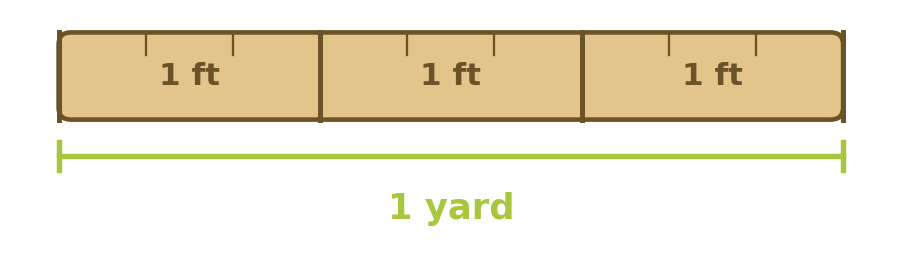
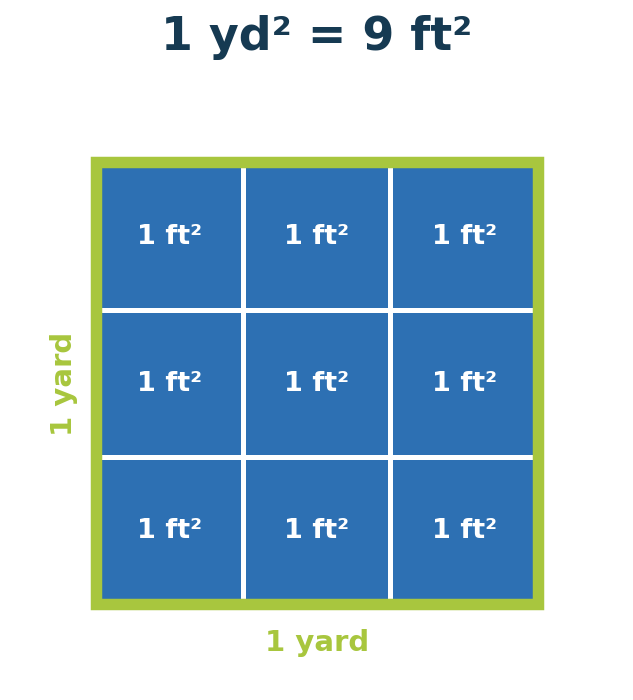
\(3\text{ ft} = 1\text{ yd}\)
square both sides
\((3\text{ ft})^2 = (1\text{ yd})^2\)
\(9\text{ ft}^2 = 1\text{ yd}^2\)
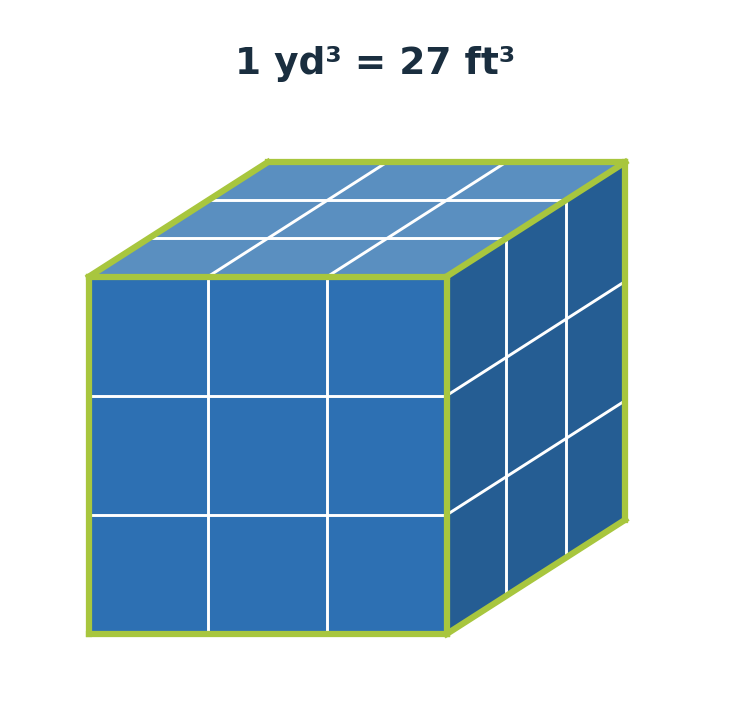
\(3\text{ ft} = 1\text{ yd}\)
cube both sides
\((3\text{ ft})^3 = (1\text{ yd})^3\)
\(27\text{ ft}^3 = 1\text{ yd}^3\)

Cubic feet to cubic inches.

Problem · your turn: 30 sec, then GO
A bathtub holds 10 cubic feet of water. How many cubic inches is that? (1 ft = 12 in)
1 ft = 12 in, so cube both sides: \((1\text{ ft})^3 = 12^3 = 1728\text{ in}^3\)
10 ft³
1
×
1728 in³
1 ft³
= 17,280 in³
A120used 12, not 12³
B17,280✓
C1,728that's just 1 ft³
D1,440squared, not cubed
02
Read it

Find the data
first.

Tables and graphs look busy. The skill is grabbing the one number the question asks for.

Make the labels meet.

How many Grade 10 students are in Robotics?
ClubGrade 9Grade 10Total
Chess81220
Robotics151025
Debate71320
Total303565
ClubGrade 9Grade 10Total
Chess81220
Robotics151025
Debate71320
Total303565
ClubGrade 9Grade 10Total
Chess81220
Robotics151025
Debate71320
Total303565
ClubGrade 9Grade 10Total
Chess81220
Robotics151025
Debate71320
Total303565
Row × column: the one shared cell is 10. (25 is the whole Robotics row, a trap.)

Which group is the whole?

Problem · your turn: 30 sec, then GO
What fraction of Grade 10 club members are in Debate?
ClubGrade 9Grade 10Total
Chess81220
Robotics151025
Debate71320
Total303565
ClubGrade 9Grade 10Total
Chess81220
Robotics151025
Debate71320
Total303565
A13/65all grades
B13/35✓
C13/20
D7/30
The named group is the whole: Grade 10 total is 35. Debate in Grade 10 is 13, so 13/35.

Pay attention to axis scales.

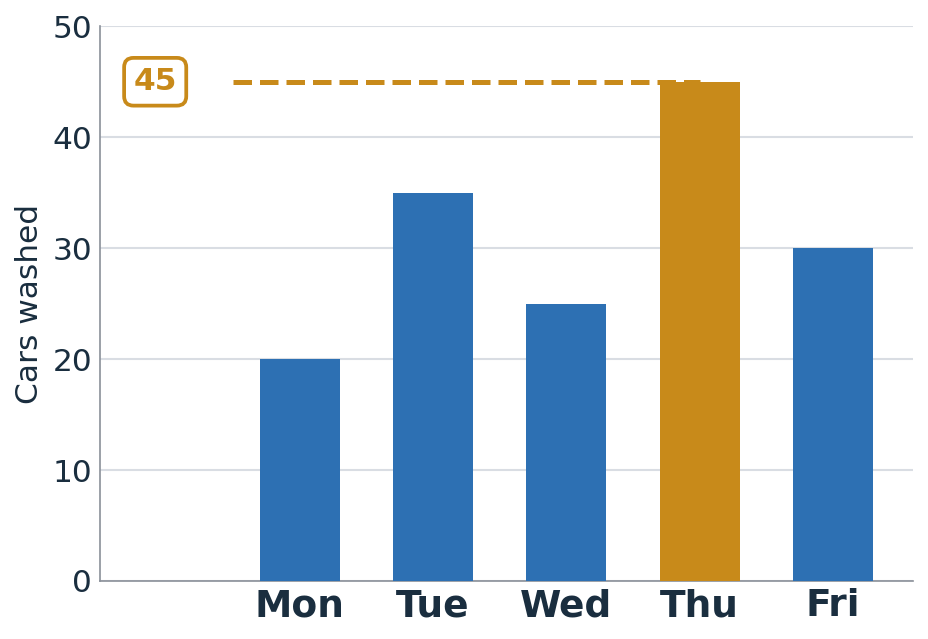
How many cars were washed on Thursday?  each labeled step = 10 cars
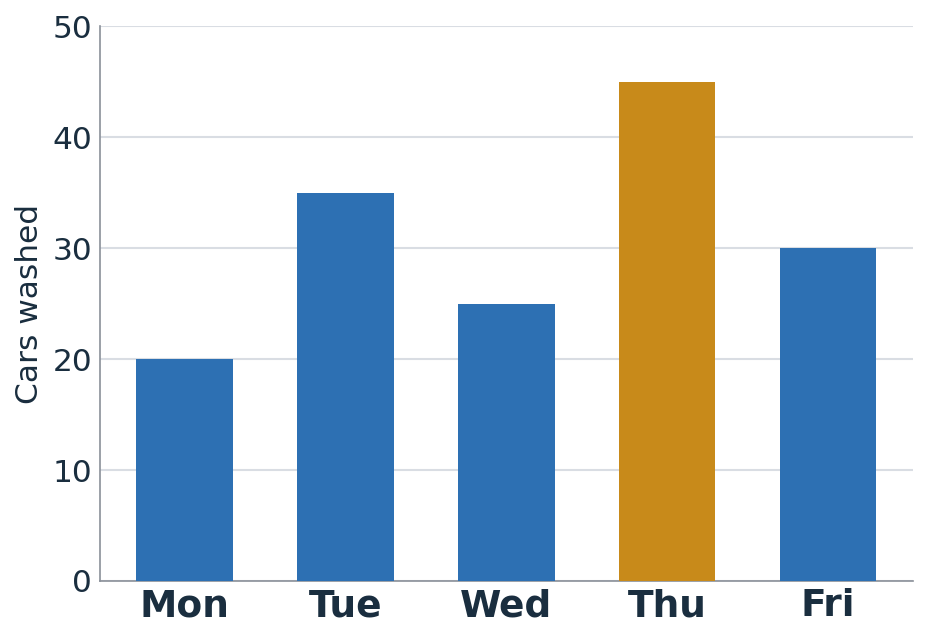
Thursday’s bar sits halfway between 40 and 50, so it is 45. Read the axis, not the bar’s height by eye.

Pay attention to axis units.

Problem · your turn: 30 sec, then GO
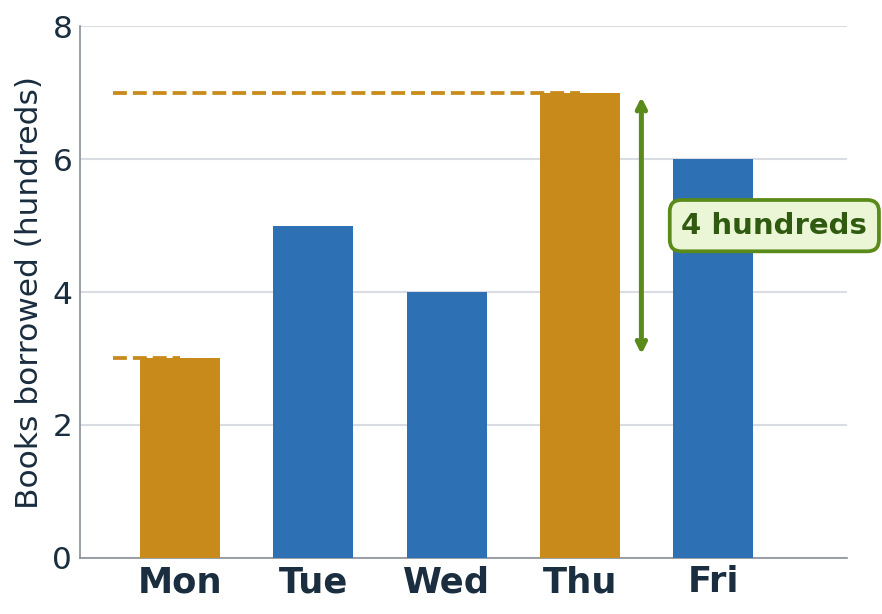
How many more books were borrowed on Thursday than on Monday?
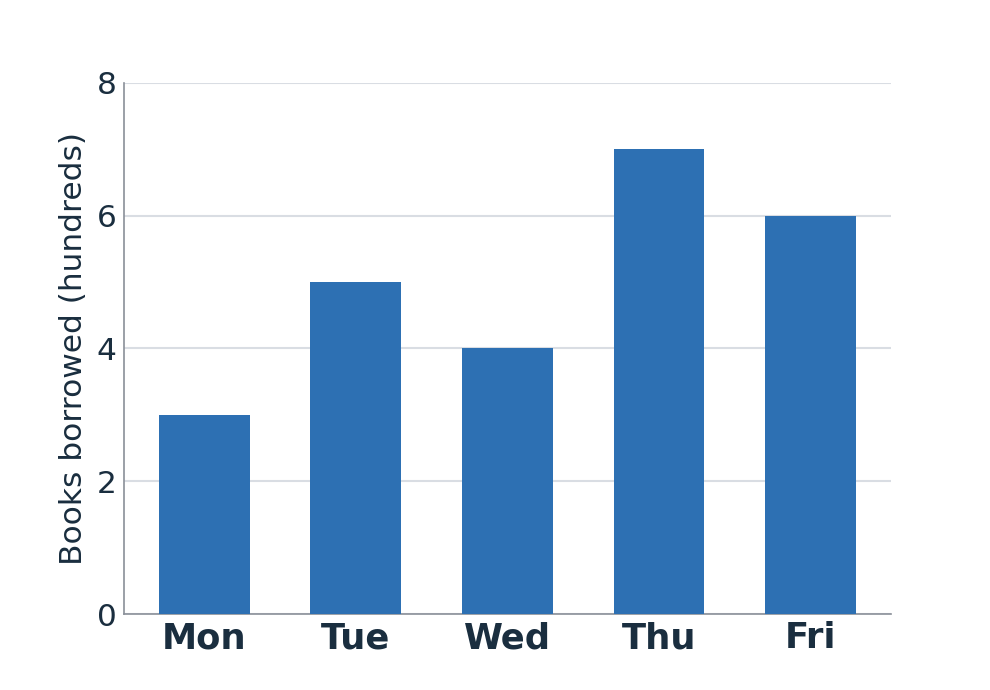
A4axis units
B400 books✓
C700
D1000
The axis is in hundreds. \((7-3)\times 100 = 400\) books. Keep the graph’s units.
03
Describe it

Center & spread.
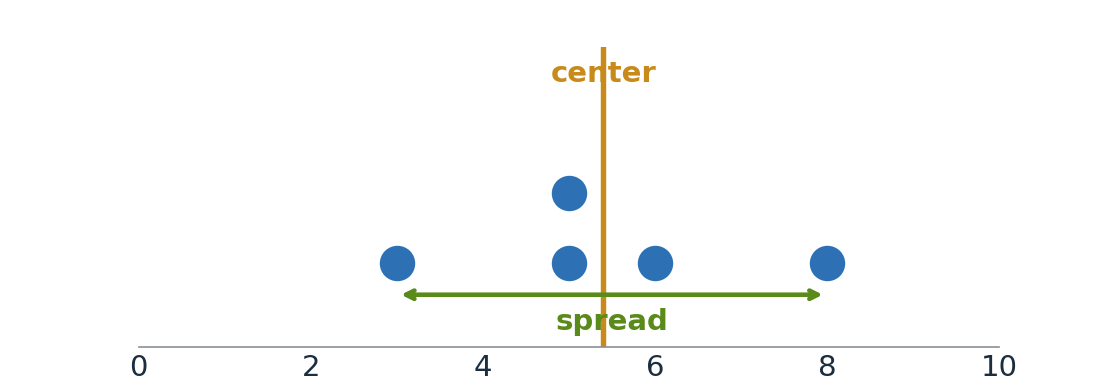
Two questions about any data set: where is the middle, and how spread out is it?

Mean is the balancing point.

Three students read 4, 8, 9 books. Where is the center?
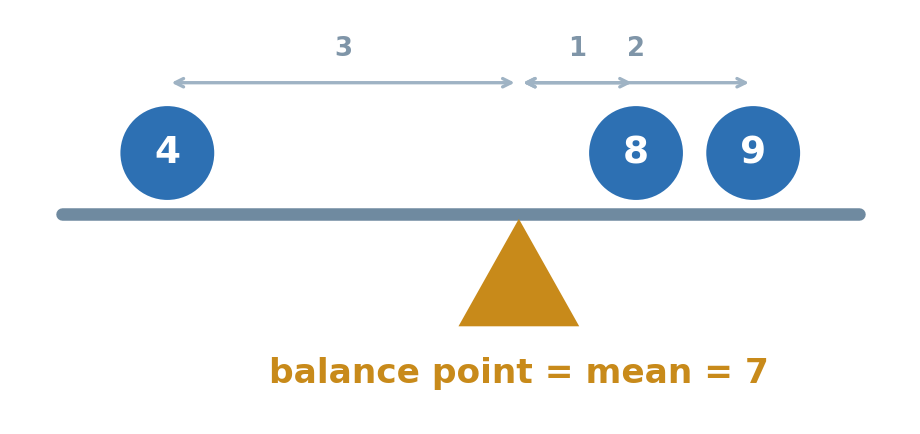
The mean is the balancing point, the center of mass. Add the values and divide by how many: \(\dfrac{4+8+9}{3} = \dfrac{21}{3} = 7\).

Median is the middle position.

Find the median (the middle).
948
489
Sort first → middle is 8
48910
Two in the middle → \(\dfrac{8+9}{2} = 8.5\)
Sort, then take the middle. If two sit in the middle, average them.

One donation changes.

Problem · your turn: 30 sec, then GO
Donations: $10, $10, $15, $15, $20. The $20 becomes $200. What happens to the mean and median?
Before
10, 10, 15, 15, 20
mean = \(\dfrac{10+10+15+15+20}{5} = \dfrac{70}{5} = 14\)
median = $15
After
10, 10, 15, 15, 200
mean = \(\dfrac{10+10+15+15+200}{5} = \dfrac{250}{5} = 50\)
median = $15
ABoth increase
BMean up, median stays✓
CMean stays, median up
DBoth stay
The middle value is still $15, so the median holds. The mean jumps $14 → $50. One outlier moves the mean, not the median.

Range sees only the ends.

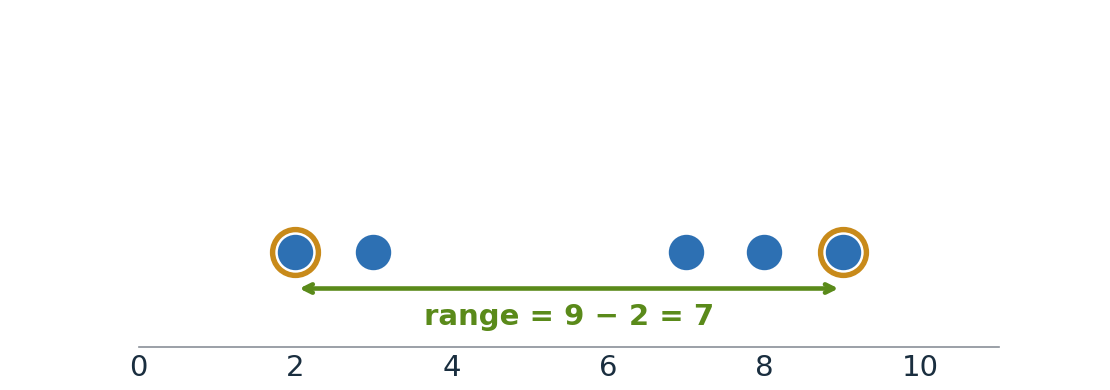
Range = biggest − smallest.
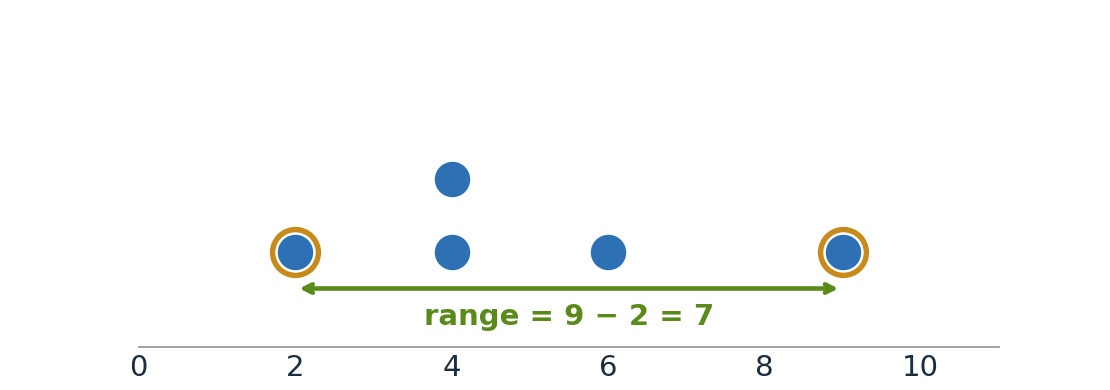
Range only sees the two endpoints (\(9-2=7\)). Change the middle values and the range does not budge.

SD is the average distance from the mean.

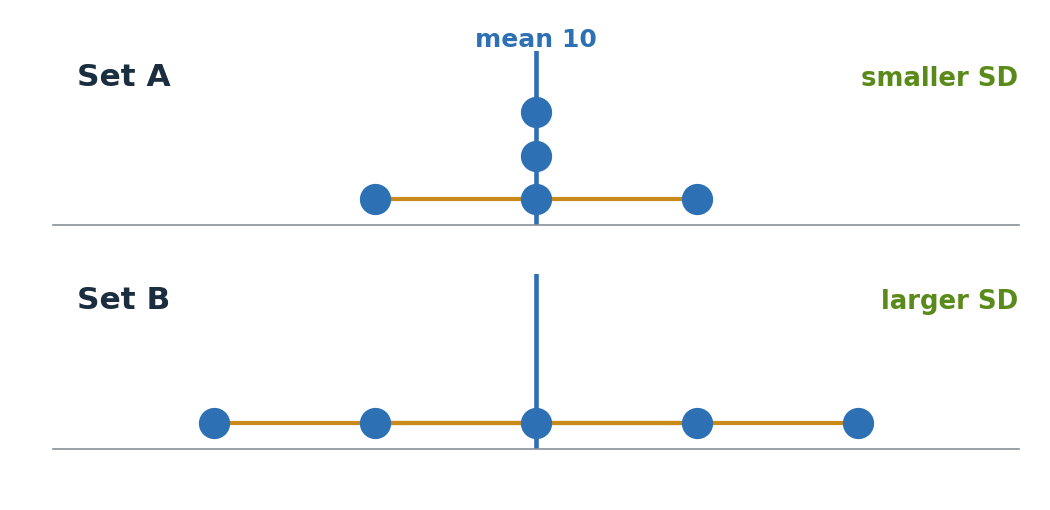
Standard deviation ≈ the average distance of each point from the mean. Both sets have mean 10.
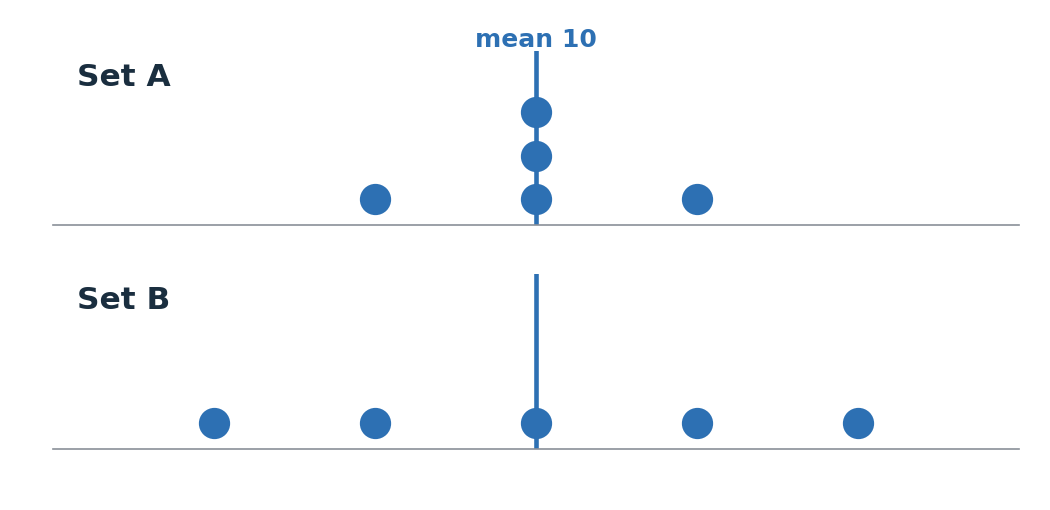
Roughly, SD is how far each value sits from the mean, on average. A tighter cluster means a smaller average distance, so a smaller SD. For clear comparisons like this, no formula is needed.

Same range. Same SD?

Problem · your turn: 30 sec, then GO
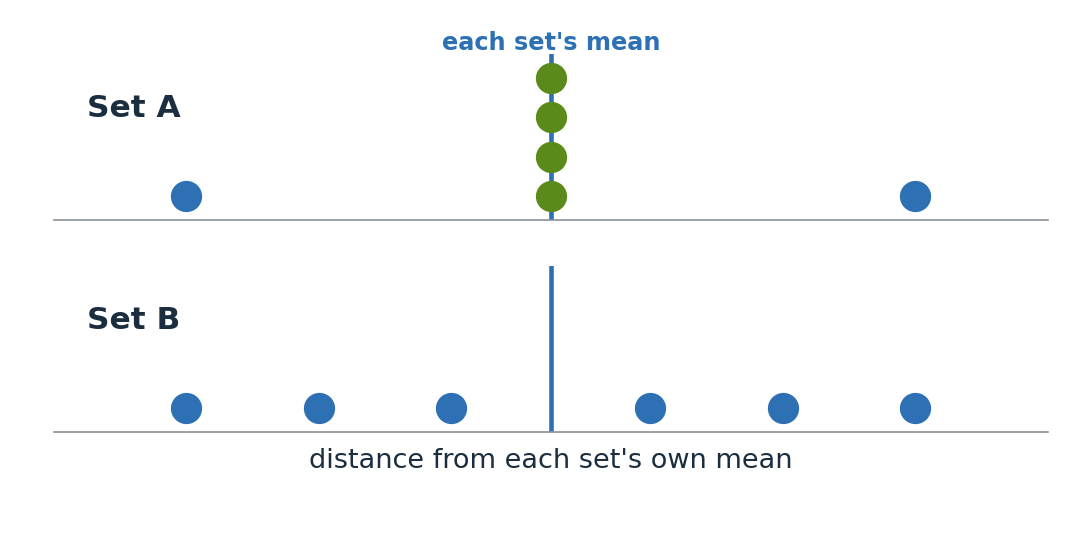
A: 30, 41, 41, 41, 41, 52    B: 8, 12, 16, 22, 26, 30. Which has the greater standard deviation?
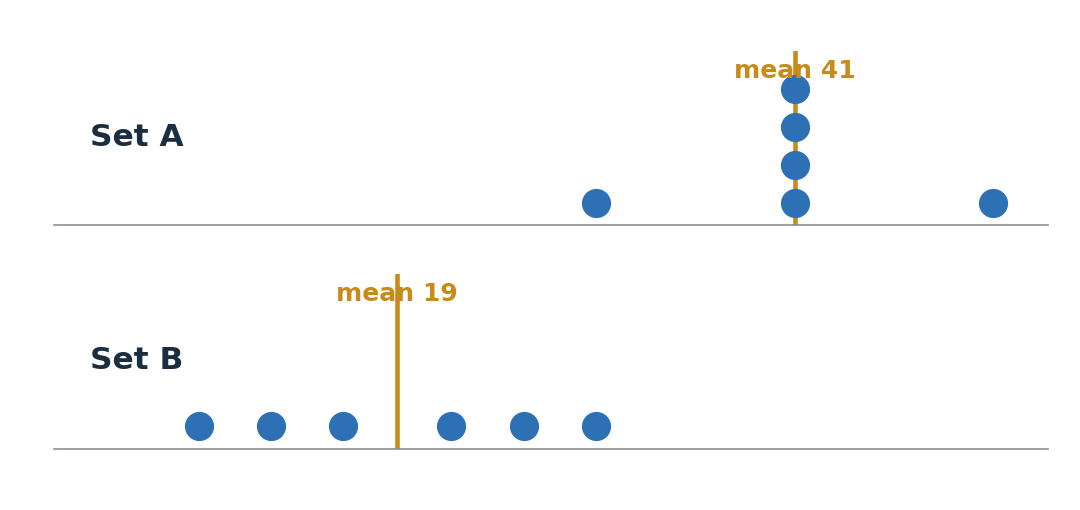
ASD(A) > SD(B)
BSD(A) < SD(B)✓
CEqualsame range, not SD
DCannot determine
Both ranges are 22, so range cannot decide. Centered on each mean, A hugs 0 while B spreads out, so B’s SD is larger.
What will you do first?

Three moves.

Before each caption appears, call out the first move in the chat.

$60
Scale it
Name the base or units.
Read it
Follow the labels.
Describe it
Center or spread?

Try three more this week.

3
Three questions, one from each theme, with worked answers.
Try → check → explain one mistake out loud.
BB
The official Bluebook app, for full-length practice.
FREE · EVERY WEEK

Scan for practice + answers
highperformancetutoring.com
GREAT WORK TODAY

One question
before you go?

NEXT WEEK
Math: Quadratics, Exponentials & Functions
Thursday, Oct 15  ·  5:00 PM PT

REJOIN ANY SESSION zoom.us/j/89849937335 Bring a friend next week.