
High Performance
Tutoring
Free Weekly SAT Workshops · Week 7
Linear Equations
& Algebra.
Stop grinding. Start working the shortcuts.
Live on Zoom
100% Free
No registration
SAT algebra isn't about doing more math. It's about doing less of it, smarter.
Hi, I'm Victor.
Your Instructor
- Founder of High Performance Tutoring (est. 2011)
- Chief architect of HPT's SAT program
- 23 years teaching & tutoring math, science & test prep
- PhD candidate in mathematics
- Helped hundreds of students raise their SAT score
- Helped thousands of students improve their grades

Slope-intercept form.
Linear Equation
\(y\;=\)\(\;m\)\(x\:+\)\(\:b\)

\(m\) = slope (rate of change)
How much \(y\) changes every time \(x\) goes up by 1.
- •miles per hour
- •dollars per month
- •cookies per pound of sugar

\(b\) = y-intercept (the start value)
The value of \(y\) when \(x\) = 0. The starting amount.
- •starting account balance
- •cards in a collection at the start
- •a flat delivery fee
In context
A gym charges a $40 sign-up fee plus $25 a month.
Let \(x\) = the number of months since signing up for the gym membership.
Let \(y\) = the total cost, in dollars.
\(y\;=\)\(\;25\)\(x\:+\)\(\:40\)
25 = cost per month (the rate)
40 = cost before any months (the start)

Try it on a real SAT question.
Problem
\(C(h) = 18h + 25\)
The function \(C\) gives the total cost, in dollars, of renting a kayak for \(h\) hours. What does \(18\) represent in this context?
AThe cost, in dollars, for each additional hour of rental✓ the rate
BThe one-time reservation cost, in dollarsthat's \(25\)
CThe total cost, in dollars, of the kayak rentalnot a fixed total
DThe total cost, in dollars, of a \(1\)-hour rentalthat's \(\$43\)

THE RULE
The number multiplying \(h\) is the slope, the rate. The cost rises \(\$18\) for each added hour.
Try it on a real SAT question.
Problem
\(g = 15t + 80\)
A pump adds water to a storage tank at a constant rate. The equation gives the amount of water \(g\), in gallons, in the tank \(t\) minutes after the pump is turned on. What does \(80\) represent in this context?
AThe amount of water added each minute, in gallonsthat's \(15\)
BThe amount of water in the tank after \(1\) minute, in gallonsthat's \(95\)
CThe number of minutes the pump runsnot a time
DThe amount of water in the tank when the pump is turned on✓ the start

THE RULE
The y-intercept is the value when \(t = 0\), before the pump runs. Here that's the \(80\) gallons already in the tank.
Standard Form.
Linear Equation
\(A\)\(x\:+\)\(\:B\)\(y\;=\)\(\;C\)
\(A\) — the rate for \(x\)
How much \(C\) goes up for each \(1\) added to \(x\).
- •dollars per adult ticket
- •calories per burger
- •points per basket

\(B\) — the rate for \(y\)
How much \(C\) goes up for each \(1\) added to \(y\).
- •dollars per child ticket
- •calories per drink
- •points per free throw

\(C\) — the total
The total that the two groups add up to.
- •total dollars raised
- •total calories eaten
- •total points scored
In context
A fundraiser sells wristbands for \(\$3\) each and t-shirts for \(\$10\) each, raising \(\$170\) in all.
Let \(x\) = the number of wristbands sold.
Let \(y\) = the number of t-shirts sold.
\(3\)\(x\:+\)\(\:10\)\(y\;=\)\(\;170\)
\(3\) = price per wristband (the rate for \(x\))
\(10\) = price per t-shirt (the rate for \(y\))
\(170\) = the total money raised

Try it on a real SAT question.
Problem
\(40c + 65p = 2{,}600\)
The equation represents a delivery van carrying \(c\) crates and \(p\) pallets with a combined weight of \(2{,}600\) pounds. What does \(40\) represent in this context?
AThe number of crates in the vannot a count
BThe weight, in pounds, of each crate✓ per crate
CThe weight, in pounds, of each palletthat's the \(65\)
DThe combined weight of the crates and palletsthat's \(2{,}600\)
THE RULE
The coefficient of \(c\) is the weight of one crate. Each crate weighs \(40\) pounds.
Try it on a real SAT question.
Problem
\(9j + 4w = 540\)
The equation gives the total calories Priya burns by jogging for \(j\) minutes and walking for \(w\) minutes. What does \(4\) represent in this context?
AThe number of minutes Priya walksnot a time
BThe calories she burns per minute of joggingthat's the \(9\)
CThe calories she burns per minute of walking✓ per walking min
DThe total number of calories she burnsthat's \(540\)
THE RULE
The coefficient of \(w\) is the rate for walking. Priya burns \(4\) calories for each minute she walks.
Try it on a real SAT question.
Problem
\(3s + 5l = 90\)
The equation represents paint bought in \(s\) small cans (\(3\) liters each) and \(l\) large cans (\(5\) liters each). What does \(90\) represent in this context?
AThe total number of cans boughtnot a count
BThe liters of paint in each small canthat's the \(3\)
CThe liters of paint in each large canthat's the \(5\)
DThe total liters of paint bought✓ the total
THE RULE
The constant on the right is the total. The painter bought \(90\) liters of paint in all.
Test out the answers.
1

Plug in numbers
When the choices are numbers, test each one in the equation and keep the one that works.
EXAMPLEWhat is the solution to \(3(x-2)=x+4\)?
A\(x = 3\)
\(3(3-2)=3+4\)→\(3(1)=7\)→\(3 \ne 7\)
B\(x = 5\)
\(3(5-2)=5+4\)→\(3(3)=9\)→\(9 = 9\) ✓
C\(x = 7\)
\(3(7-2)=7+4\)→\(3(5)=11\)→\(15 \ne 11\)
D\(x = 9\)
\(3(9-2)=9+4\)→\(3(7)=13\)→\(21 \ne 13\)
2

Test formulas
When the choices are functions, test each against the data points and keep the one that fits them all.
EXAMPLEWhich function passes through \((0,5), (1,10), (2,20)\)?
A\(y = 5x + 5\)
\((2,20)\)→\(5(2)+5\)→\(15\)→\(\ne 20\)
B\(y = 5 \cdot 2^{x}\)
\(5,\ 10,\ 20\)→fits all three ✓
C\(y = 5x^2 + 5\)
\((2,20)\)→\(5(2)^2+5\)→\(25\)→\(\ne 20\)
D\(y = 10x\)
\((0,5)\)→\(10(0)\)→\(0\)→\(\ne 5\)
Try it on a real SAT question.
Problem
\(\dfrac{2}{3}x + 4 = 10\)
What is the value of \(x\)?
A\(x = 4\)gives \(6\tfrac{2}{3}\)
B\(x = 6\)gives \(8\)
C\(x = 9\)✓ gives \(10\)
D\(x = 21\)gives \(18\)
THE MOVE
Skip the fraction algebra. Put each choice into the left side; only \(x = 9\) makes it equal \(10\).
Try it on a real SAT question.
Problem
| \(x\) | \(y\) |
| \(0\) | \(3\) |
| \(1\) | \(6\) |
| \(2\) | \(12\) |
The table shows three values of \(x\) and \(y\). Which function \(f\) models the data?
A\(f(x) = 3x + 3\)✗ gives \(9\) at \(x=2\)
B\(f(x) = 3 \cdot 2^{x}\)✓ fits all three
C\(f(x) = 6x\)✗ gives \(0\) at \(x=0\)
D\(f(x) = 3x^2 + 3\)✗ gives \(15\) at \(x=2\)
THE MOVE
Test each function against all three points. Only \(f(x) = 3 \cdot 2^{x}\) gives \(3, 6, 12\). The linear and quadratic fit the first points but miss \((2, 12)\).
Pick your own numbers.
The signal
The choices use the same letters as the problem? Pick easy numbers, then compute and match.

Equivalent expressions
Which choice equals the given one?
- •rational functions
- •polynomials, exponents, radicals
e.g. which equals \(\dfrac{x^2-9}{x-3}\)?

In terms of
Rearrange, or build a quantity from the letters.
- •solve for a variable
- •“which expression gives…”
e.g. \(d = rt\): solve for \(t\)

No numbers given
Relationships, but no amounts given.
- •percent up then down (pick 100)
- •a number tripled, halved…
e.g. up \(20\%\), then down \(20\%\)?
Pick easy numbers, but avoid \(0\) and \(1\). If two choices tie, pick a second number to break it.
Try it on a real SAT question.
Problem · equivalent expressions
\(\dfrac{6x(x-4)-5(x-4)}{3x-12}\)
For \(x>4\), which expression is equivalent to the one above?
1
Let's try using \(x = 5\). The choices use \(x\), and the problem says \(x > 4\).
2
Plug it into the question expression: \(\dfrac{6(5)(1)-5(1)}{15-12} = \dfrac{25}{3}\)
3
Plug \(x=5\) into each choice. Which one also gives \(\frac{25}{3}\)?
A\(6x - 5\)\(6(5)-5 = 25\)
B\(2x(x-4) - 5(x-4)\)\(2(5)(1)-5(1) = 5\)
C\(\dfrac{6x - 5}{3}\)\(\dfrac{6(5)-5}{3} = \dfrac{25}{3}\) ✓
D\(2x - 5\)\(2(5)-5 = 5\)
Try it on a real SAT question.
Problem · in terms of
\(k(m + 3) = 5m - 2\)
Here \(k\) is a constant and \(k \ne 5\). Which expression gives \(m\) in terms of \(k\)?
1
Pick a value for \(m\), because then solving for \(k\) is one step. Let's use \(m = 2\).
2
Solve for \(k\): \(k(2+3)=5(2)-2\), so \(5k = 8\) and \(k = \frac{8}{5}\).
3
Plug \(k = \frac{8}{5}\) into each choice. Which one gives back \(m = 2\)?
A\(m = \dfrac{3k + 2}{5 - k}\)\(= 2\) ✓
B\(m = \dfrac{5}{5 - k}\)\(= \frac{25}{17}\)
C\(m = \dfrac{3k + 2}{k - 5}\)\(= -2\)
D\(m = \dfrac{3k + 2}{5}\)\(= \frac{34}{25}\)
Tip: stuck on the fractions? This is a perfect moment for Desmos. Picking a number turns the algebra into arithmetic, and Desmos is great at arithmetic.
Try it on a real SAT question.
Problem · no numbers given
A jacket's price is increased by \(20\%\). Then that new price is decreased by \(20\%\). The final price is what percent of the original price?
1
No starting price is given, so pick one. \(\$100\) is easiest for percents.
2
Increase by \(20\%\): \(100 \times 1.2 = \) \(\$120\).
3
Decrease by \(20\%\): \(120 \times 0.8 = \) \(\$96\), which is \(96\%\) of the original.
A\(100\%\)the trap: it doesn't cancel
B\(96\%\)✓ the \(\$96\)
C\(90\%\)✗
D\(104\%\)✗
Find the vertex.
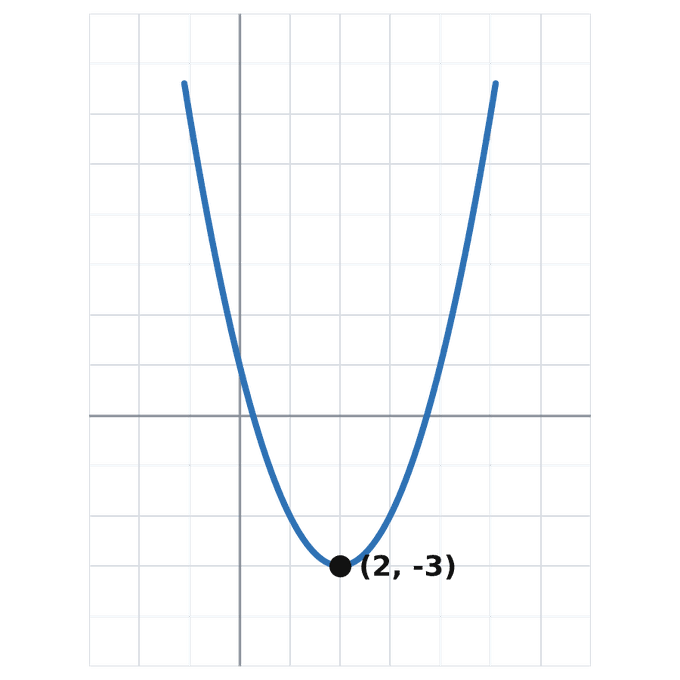
The vertex is a parabola's turning point, its lowest or highest value. Type the function into Desmos:
STRATEGY
Desmos marks the vertex for you, so there's no completing the square and no \(-\frac{b}{2a}\).
Find the x-intercepts.
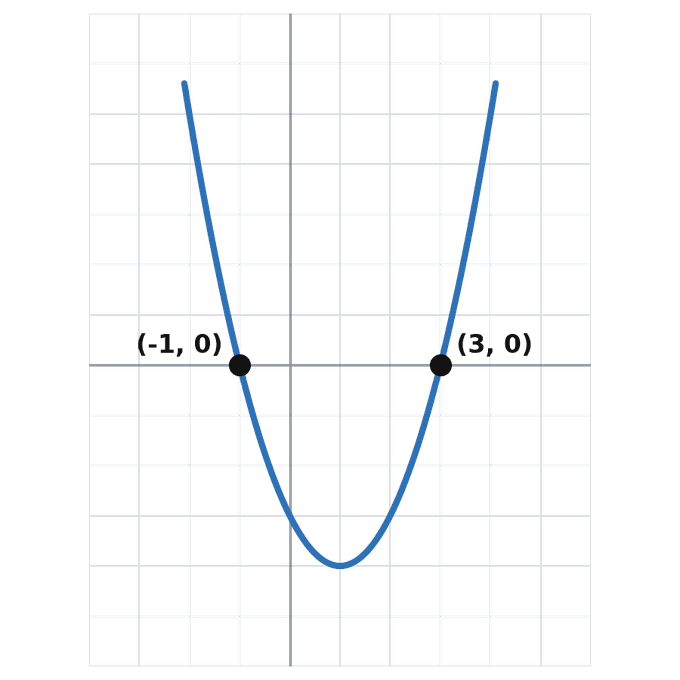
The x-intercepts are where the graph crosses the x-axis, the solutions of the equation. Type the function in:
STRATEGY
Desmos finds the x-intercepts for you, so you don't burn minutes factoring or using the quadratic formula.
Find the intersection.
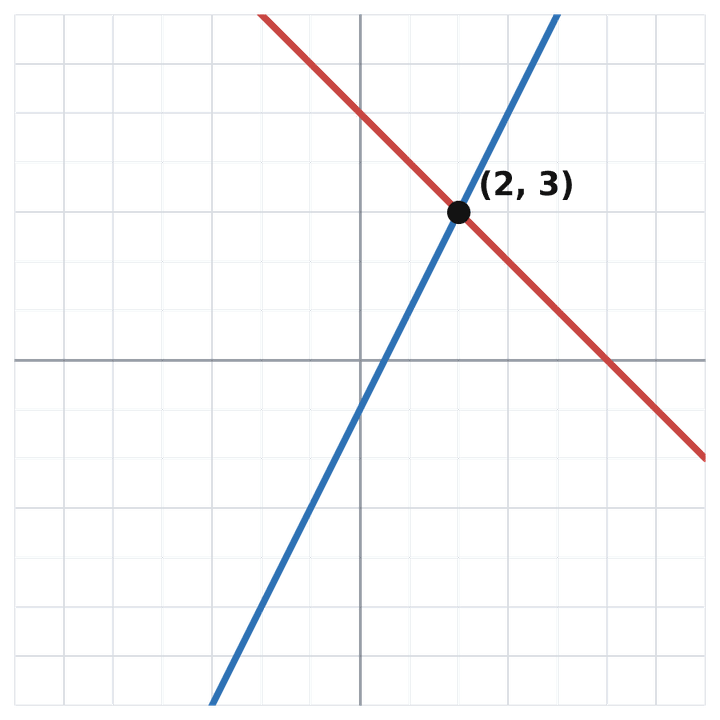
A system's solution is where the two lines cross. Type both equations in, even in standard form:
STRATEGY
Desmos finds the intersection for you, so there's no elimination and no substitution. Standard form graphs fine, no need to convert.
One, none, or infinitely many.
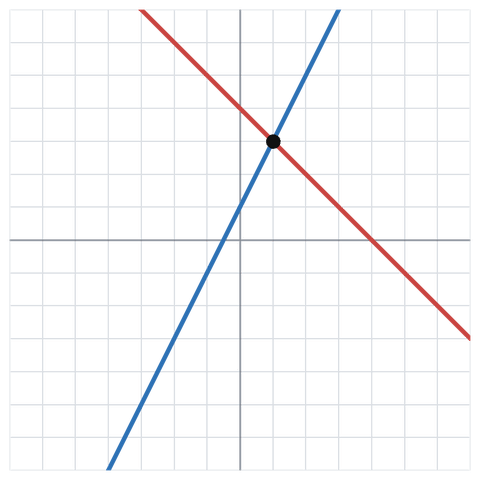
One solution
Different slopes. The lines cross once.
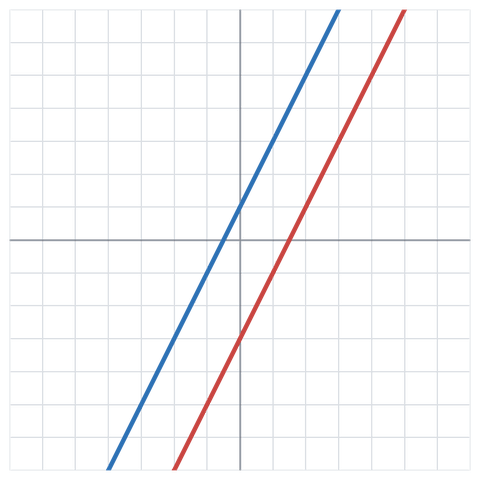
No solution
Same slope, different intercept. Parallel, never touch.
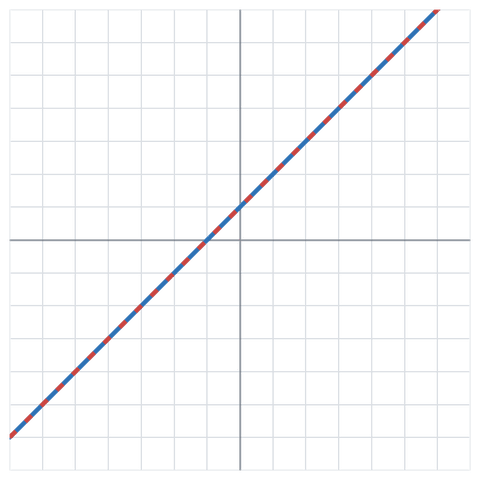
Infinitely many
The same line twice. Every point works.
The SAT loves to ask for the value of \(k\) that makes a system have no or infinitely many solutions. In Desmos, put in the value and watch: do the lines cross, run parallel, or land on top of each other?
Try it on a real SAT question.
Problem
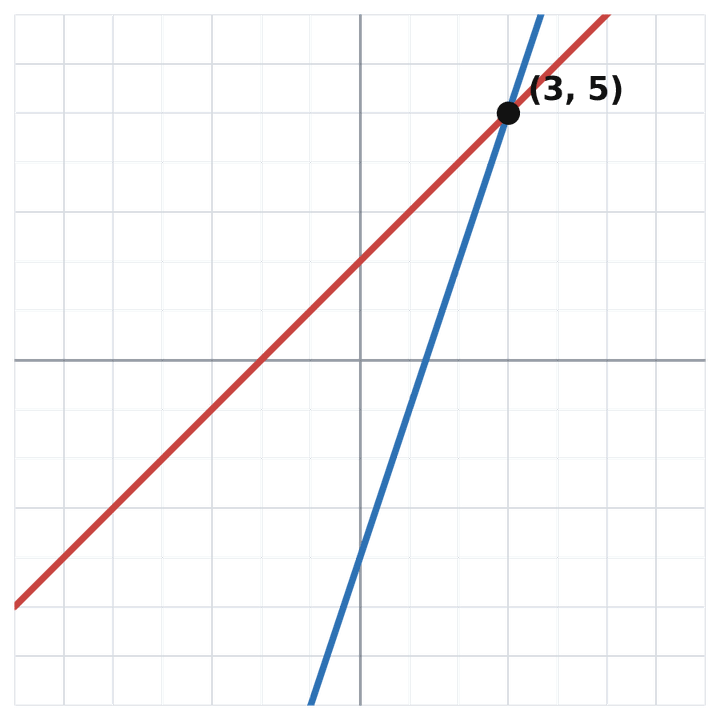
\(y = 3x - 4\)and\(y = x + 2\)
The graphs of these two lines intersect at a single point. What is the value of \(x + y\) at that point?
A2that's y − x
B6only the x, doubled
C8✓ 3 + 5
D10too high
THE MOVE
Graph both in Desmos. They cross at \((3, 5)\), so \(x = 3\) and \(y = 5\). That gives \(x + y = 8\).
Try it on a real SAT question.
Problem
\(y = 4x - 7\)and\(12x - ky = 21\)
In the system above, \(k\) is a constant. If the system has infinitely many solutions, what is the value of \(k\)?
A\(-3\)wrong sign
B\(3\)✓ same line
C\(1/3\)flipped
D\(12\)just a coefficient
THE MOVE
Infinitely many solutions means one line, so the two graphs sit right on top of each other. In Desmos, just try each choice for \(k\): only \(k = 3\) makes the second line land exactly on the first.
Your algebra checklist.
✓Interpret: read the coefficients. In \(y = mx + b\), slope and start; in \(Ax + By = C\), each coefficient is a rate and \(C\) is the total. Don't convert.
✓Substitute: test the answers (plug in numbers, or test a formula against the data), or pick your own numbers when the choices share the problem's letters.
✓Graph it: let Desmos find the vertex, the x-intercepts, where lines cross, or the number of solutions. No algebra.

Download the Bluebook App
•The exact app you’ll use on test day, and it has Desmos built right in.
•8 real practice tests, made by the College Board.
•Automatically timed and scored, a great way to get a baseline.
Further practice and resources.

PRACTICE
Targeted practice problems on today's skills.
REVIEW
This slide deck, to revisit anytime you want.
SCHEDULE
The full workshop lineup for the season.
UPDATES
Sign up for email reminders, if you haven't yet.
FREE · EVERY WEEK
Your gateway to
free resources
free resources

Scan to explore
highperformancetutoring.com
Students & parents welcome · no obligation
GREAT WORK TODAY
You did the work.
Bring a friend next week.
NEXT WEEK
Math: Problem-Solving & Data
Thursday, Oct 8 · 5:00 PM PT

REJOIN ANY SESSION
zoom.us/j/89849937335
Meeting ID 898 4993 7335
Want a plan built around your score? Free consult at highperformancetutoring.com.